Saturday, 31 May 2025

भीम - महाभारताचा नायक !

सर्वसाधारणपणे महाभारताच्या कोणत्याही वाचकाला जर “महाभारताचा नायक कोण?” असा प्रश्न विचारला तर बहुतांशी वाचक एकमतानी सांगतील की महाभारताचा नायक अर्जुन होता, तर काही हुशार मंडळी कृष्णाला महाभारताचा नायक ठरवतील. कर्णाला व दुर्योधनालाही नायक ठरवणारी मंडळी कदाचित सापडतील, पण भीमाला नायक म्हणणारे विरळाच.

महाभारतात भीमाचा त्याच्या जन्माच्या कथेनंतर जो उल्लेख येतो तो एक दांडगोबा म्हणून. त्याच्या दांडगाईचे लक्ष अर्थात कौरव बंधु असत. कधी नदीत पोहताना त्यांचा जीव अगदी घाबरा होई पर्यंत पाण्यात त्यांची डोकीच दाबून धर आणि मग त्यांनी महामुश्कीलीने डोकी पाण्यावर काढून श्वास घेतला की दृष्टीस पडे तो खदा खदा हसणारा भीम आणि त्याच्यासोबत ही फजिती बघून हसणारे बाकीचे पांडव. कधी पोहून झाल्यावर कपडे बदलून तीरावर उभ्या असलेल्या कौरव बंधूंना बाजूच्या झाडावरून धबाक्करून पाण्यात उडी टाकून भिजव वा मागून येऊन धक्का देऊन त्यांना पाण्यात पाड. तर कधी शक्तीप्रयोगात चार चार कौरवांना आखाड्याच्या मातीत सहज घुसळून काढ. हे सगळे भीमाचे खेळ असत एखाद्या सामान्य दांडगट मुलांसारखे, त्यात ना कुठे दुष्टावा, ना कौरवांना इजा पोहोचविण्याचा इरादा असे. दुर्योधनाने आणि त्याच्या बंधूनी मात्र पांडवांना केवळ सत्तेचे प्रतिस्पर्धी ह्या नात्याने बहुदा शत्रू म्हणुनच बघितलं. कौरवांना सत्तेच्या मार्गातील भीम हाच सर्वात मोठा अडथळा वाटणे स्वाभाविक होते. त्यातून शकुनी सारखा मामा मिळाल्यावर मग काय विचारता!  

एकहाती, कोणाच्याही मदतीशिवाय, एकट्याने शत्रूचा निप्पात करण्याची क्षमता केवळ भीमातच होती आणि त्याची पूर्ण जाणीव दुर्योधनाला असल्यामुळे कपटाने भीमाला मारण्याचे अनेक प्रयत्न कौरवांनी केले. त्यातील सर्वात घातक म्हणजे कौरवांनी भीमावर केलेला विषप्रयोग. विषप्रयोगाने बेशुद्ध झालेल्या भीमाला दोरखंडांनी जखडून गंगेच्या डोहात बुडवून दुर्योधन आणि मंडळी साळसूदपणे माघारी परतली. त्यांच्या दुर्दैवाने म्हणा किंवा भीमाच्या सुदैवाने म्हणा गंगेच्या डोहात वासुकीबरोबर (नाग लोकीचा राजा) आलेल्या आर्यकाने (आर्यक- कुंतीच्या पित्याचे, शुरसेनाचे मातुल आजोबा) वासुकीला भीमाची ओळख पटवून दिली. इतकेच नव्हे तर वासुकीकडील रसकुंडातील (मधाचे कुंड – ज्याच्या प्राशनाने, अतुलनीय सामर्थ्य निर्माण होते) रस प्राशन करण्याची अनुमती भीमाला मिळवून दिली. परिणामतः पहिल्यापेक्षा अधिक शक्तिशाली होऊन भीम हस्तिनापुरी परत आला.

या प्रसंगानंतर कौरवांच्या उद्देशाबद्दल पांडवांच्या मनात कसलाही संदेह राहिला नाही. त्यामुळे दुर्योधनाला एकट्याला पांडवांना आता फशी पाडता येणार नव्हते. तेव्हा पुत्र प्रेमाने सद्सद्विवेक हरवून बसलेल्या धृतराष्ट्राच्या मदतीने त्याने पांडवाना कुंती मातेसह वारणावताला पाठविले. कौरवांचा पांडवाना लाक्षागृहात जाळून मारण्याचा कट विदुराच्या मदतीमुळे फसला आणि त्यांच्या जागी पुरोचन (कटातला एक भागीदार) आणि रात्री आसऱ्याला आलेले एक कुटुंब मृत्युमुखी पडले. पाच पुरुष व एक स्त्री अशी सहा शवे जळलेल्या अवस्थेत सापडली. त्यांची ओळख पटण्यासारखी नसल्यामुळे पांडव व माता कुंती त्या आगीत मृत झाले अशी वदंता पसरली. आपल्या जीवाला असलेल्या धोक्याची जाणीव झाल्यामुळे पांडवांनी अज्ञातवास स्वीकारला. ब्रह्मचारी ब्राम्हण, आईबरोबर असल्याचा बनाव करीत भ्रमंती करीत होते.

ब्रह्मचारी म्हणून प्रवास करतांना वाटेतील जंगलात हिडींब राक्षसाची गाठ पांडवांशी पडली आणि आजवर त्या वनातून जाणाऱ्या वाटसरूंनचा फडशा पाडून दहशत पसरवलेल्या हिडींब राक्षसाला भीमाने यमसदनास पाठविले. पुढे एकचक्रा नगरीत रहात असतांना त्या नगरीला जाचक ठरलेला नरमांस भक्षक बक राक्षस भीमाच्या हातून मारला गेला आणि नगर वासीयांची बकासुरापासून कायमची सुटका झाली. सगळया पांडवांनी आपापल्या परीने महायुद्धात पराक्रम केला पण लोककल्याणासाठी भीमा व्यतिरिक्त त्यापैकी कोणीही आपला जीव धोक्यात घातल्याच उदाहरण सापडत नाही.

हिडींब वधानंतर त्याच्या बहिणीशी हिडींबेशी कुंतीच्या संमत्तीने भीमाने विवाह केला आणि त्या दोहोंचा पुत्र महापराक्रमी घटोत्कच महाभारतीय महायुद्धात धारातीर्थी पडला. घटोत्कचाच्या बलिदानाचा हेतू हा कर्णाला त्याची वासवी शक्ती वापरण्यास भाग पाडणे आणि पर्यायाने अर्जुनाला वाचवणे हा होता ह्याची पूर्ण कल्पना भीमाला, त्याच्या पित्याला होती. आपल्या भावासाठी पित्याने पुत्राचे बलिदान दिले.        

द्रौपदी स्वयंवराच्या वेळेला इतके सारे क्षत्रिय हजर असतांना एका ब्राह्मणाने (ब्राह्मण वेशातील अर्जुनाला न ओळखल्यामुळे) पण जिंकावा, हे सहन न झाल्यामुळे द्रौपदी स्वयंवरा नंतर अर्जुनाला झालेल्या विरोधात एकट्या भीमाने दुर्योधानासहीत, शल्य, कर्ण तथा अन्य क्षत्रिय वीरांना रोखून धरत द्रौपदीला घेऊन जाणाऱ्या अर्जुनाचा मार्ग मोकळा केला. बलाढ्य पांचाल नरेश, दृपदाशी सोयरिक जुळल्यामुळे पांडवांची बाजू वरचढ झाली आणि ते प्रकट (अज्ञातवासातून) झाले आणि मोठ्या सन्मानाने हस्तिनापुरी परत आले.

धृतराष्ट्राच्या सांगण्यावरून त्याने दिलेल्या जागेवर  (खांडवप्रस्थ – खांडववन) पांडवांनी प्रस्थान केले. खांडववनाचे दहन करून इंद्राच्या अमरावातीसारखी एक सुंदर नगरी, इंद्रप्रस्थ, पांडवांनी वसवली. गुरुजनाच्या सल्याने युधिष्टीराने राजसूय यज्ञ करण्याचे योजले. राजसूय यज्ञ यशस्वी होण्यापूर्वी बाकीच्या राजांनी युधिष्टीराचे सार्वभौमत्व मान्य करून त्याला धनभार देणे आवश्यक होते. या मार्गातील सर्वात मोठा अडथळा म्हणजे मगधाचा महापराक्रमी, अत्याचारी सम्राट जरासंध, कृष्णाच्या हातून मृत्यू पावलेल्या कंसाचा सासरा,  कृष्णाचा हाड वैरी, कौरवांचा समर्थक. जरा राक्षसिणीने सांधलेला म्हणून जरासंध, राजा बृहद्रथाचा पुत्र. जरासंधाने नृपयज्ञ करण्याकरिता अनेक राजांना कैदेत टाकले होते तेंव्हा त्याचा शेवट करणे अत्यावश्यक होते. ते आव्हान पेलण्याची क्षमता केवळ भीमाकडे होती. कृष्ण, भीमार्जुना सहित वेषांतर करून जरासंधाच्या महाली पोहोचला. तिघांची ओळख सांगत त्याने जरासंधाला तीघांपैकी कोणाही एकाशी द्वंदाचे आव्हान दिले. जरासंधाने त्याच्या गर्विष्ठ स्वभावानुसार द्वंदाकरिता बलदंड भीमाची निवड केली. भीमाने आपल्या शक्ती सामर्थ्याला शोभेल असे मल्लयुद्ध करीत जरासंधाचा वध केला. युधीष्टीराचा राजसूय यज्ञाचा मार्ग मोकळा झाला. युधीष्टीराच्या चार बंधूंनी चार दिशांना जाऊन दिग्विजय केला. यथावकाश राजसूय यज्ञ यशस्वीपणे पार पडला, नाही म्हणायला, शिशुपालाचा कृष्णाच्या हातून झालेला शिरच्छेद हे गालबोट मात्र लागले.

दुर्योधनादिकांचा, पांडवांच ऐश्वर्य बघून झालेला जळफळाट, मयसभेत दुर्योधनाची झालेली फजिती, शकुनीच्या पांडवांबरोबर द्यूत खेळण्याच्या कटास धृताराष्ट्रची सहमती. विदुराकरवी आमंत्रण. द्यूतात युधीष्टीराची लांच्छनास्पद हार. द्रौपदी वस्त्रहरणाचा कुरुकुलाला लाज आणणारा प्रसंग. ह्या सर्व प्रसंगात पांडवांपैकी एकमेव, भीम ज्याच्या सहनशक्तीचा अंत झाल्यामुळे त्याने सहदेवाला अग्नी आणायला सांगितले. “जा सहदेवा अग्नी घेऊन ये, स्वतःच्या पत्नीला पणाला लावणाऱ्या धर्मराजाचे हात मला जाळू दे”. अर्जुनाने मध्यस्ती केल्यामुळे पुढील प्रसंग टळला. पण “दुःशासनाची छाती फोडुन रक्त प्राशन  करीन आणि त्या रक्ताने बरबटलेल्या या हातांनी कृष्णेचे केस बांधीन” ही भीमाची भीषण प्रतिज्ञा ऐकणाऱ्यांच्या काळजाचा थरकाप करीत दरबारात घुमली. बघण्यासारखे आहे पाच पती असतांना एकट्या भीमाने द्रौपदीच्या अपराध्यांना शासन करण्याची प्रतिज्ञा केली. महाभारतीय युद्धात भीमाने ती पूर्ण देखील केली.

इतक्या प्रतिकुल परीस्थितही द्रौपदीने प्रसंगवधान राखून आपल्या पतींना आणि द्यूतात घालविलेले राज्य, संपती, ऐश्वर्य सगळेकाही धृताराष्ट्राकडून सोडवून घेतले. इंद्रप्रस्थास परत निघालेल्या युधिष्टीराला वाटेतच धृतराष्ट्राने दिलेले अनुद्यूताचे आमंत्रण पोहोचले. काकांची इच्छा व क्षत्रिय द्यूताचे आमंत्रण नाकारू शकत नाहीत अशा सबबीखाली युधिष्टिर परत द्यूत खेळण्यास बसला आणि पुनश्च सर्व घालवून पांडवांच्या पदरात १२ वर्षांचा वनवास आणि १ वर्ष अज्ञातवास घेतला. इतकच नव्हे तर जर अज्ञातवासात ओळख पटली तर पुन्हा तितकाच वनवास आणि अज्ञातवास.

वनवासात असतांना पांडवांनी काम्यक वनात राहण्याचे ठरवले. पांडवांबरोबर धौम्य ऋषी, अनेक ब्राह्मण व ऋषी देखील होते. पांडव आपल्या बरोबरच्या जथ्या सहित काम्यक वनात पोहोचले. काम्यक वनात किरमिरा (बकासुराचा भाऊ) राक्षसाचे राज्य असल्यासारखे होते. किरमिरा राक्षसाच्या भीतीने गुराखी आपल्या गाई, गुरांना वनात नेत नसतं. गावकरी, पांथस्त काम्यक जंगलातून येजा करीत नसतं. बकासुराचा भाऊच तो, नरभक्षक, त्याने पांडवांची वाट अडवली. युधिष्टीराने आपली व आपल्या बंधूंची आणि पत्नीची ओळख करून देत त्याला वाट सोडण्याची विनंती केली. भीमाचे नाव ऐकताच आपल्या भावाच्या मृत्युचा सूड घेण्याकरता उतावीळ झालेल्या किरामिराने भीमावर चाल केली आणि दोघांचे द्वंद जुंपले. त्याची परिणीती अर्थात व्हायची तीच झाली. किरमिराचा अंत झाला आणि काम्यक वन व तेथील नागरिक भयमुक्त झाले.

पाची पांडव मृगयेसाठी दूर दूर वनात गेलेले असतांना द्रौपदी धौम्य ऋषीं सोबत आश्रमात एकटीच होती. ती आपली पतींची वाट बघत उभी असतांना आपल्या लवाजम्यासह मृगयेकरिता आलेल्या जयद्रथाची नजर तिच्यावर पडली. जयद्रथ (सिंधू, शिबी आणि सौरवी देशांचा राजा, वृद्धक्षत्राचा मुलगा, नात्याने कौरवांचा आणि पांडवांचा मेहुणा, दुःशलेचा पती). द्रौपदीच्या सौंदर्याने वेडा झाला आणि द्रौपदीच्या, धौम्य ऋषींच्या विनविण्यांना, धमक्यांना भिक न घालता तिला रथात घालून निघाला. पांडवांना ही गोष्ट कळताच त्यानी वायुवेगाने जयद्रथाच्या लवाजाम्याला गाठले. जयद्रथाच्या पथकात आणि पांडवांच्या मध्ये अभूपूर्व धुमश्चक्री सुरु झाली. अर्जुनाने व भीमाने जयद्रथाच्या सैन्याची अक्षरशः दाणादाण उडवली. भीमाचे रौद्र रूप बघूनच सगळयांना पाळता भुई थोडी झाली. द्रौपादीला सोडून जयद्रथाने पळण्याचा प्रयत्न केला. संतप्त भिमार्जुनांनी त्याला गाठले. भीमाने त्याला रथखाली ओढून मारत धर्मासमोर आणले. द्रौपदी आणि भीमाने त्याच्या मृत्यूचीच अपेक्षा धरली होती. पण क्षमाशील युधिष्टीराने नात्याचा संदर्भ देत त्याला क्षमा केली. भीमाने जयद्रथ पांडवांचा गुलाम आहे असे त्याच्याकडून वदवून घेतले आणि धारधार शस्त्राने त्याच्या डोक्यावर केसांचे पाट काढून त्याची सुटका केली.    

आपलं राज्य परत मिळविण्याकरिता युद्ध अपरिहार्य आहे हे पांडवांच्या लक्षात आलं. त्या युद्धाच्या तयारीचा भाग म्हणून व्यासांच्या सल्ल्याने युधिष्टीराने अर्जुनाला महेंद्र, रुद्र, वरुण, कुबेर आणि यमाकडे जाऊन अमोघ अस्त्र प्राप्त करण्यास सांगितले. युधीष्टीराच्या आज्ञेनुसार अर्जुन काम्यक वनातून बाहेर पडून हिमवत पर्वतात जाण्यास निघाला.

युधीष्टीराबरोबर असलेल्या ब्रह्मवृन्दात ब्राह्मण म्हणून वेषांतर करून सामील झालेला जटासूर द्रौपदीला पळविण्याकरिता संधीची वाट बघत होता. अस्त्रविद्या मिळविण्याकरिता अर्जुन आधीच लांब गेला होता. भीम दूर जाण्याची तो वाट बघत होता. एकदिवस भीम शिकारीसाठी लांब खोल अरण्यात गेल्याची वेळ साधून जटाने आपले अवाढव्य खरे रूप घेतले आणि एका हातात युधिष्टिर, नकुल व सहदेव आणि दुसऱ्या हातात द्रौपदीला घेऊन झपाट्याने निघाला. पांडवाना कसलाही विरोध करण्याची संधीच मिळाली नाही. सहदेवाने मोठ्या मुष्किलीने स्वतःची सुटका करून घेतली आणि त्याने भीमाला गाठुन झाला प्रकार सांगितला. भीम वायुवेगाने जटासूरा समोर त्याची वाट अडवून उभा ठाकला. जटाला प्रत्यक्ष कळीकाळच समोर दिसला. झालेल्या द्वंदात संतप्त भीमाने जटासूराला यमाकडे पाठविले आणि द्रौपदी, युधिष्टिर व नकुलाची सुटका केली.

वेगवगळ्या अरण्यातून प्रवास करीत पांडव कैलास पर्वताच्या पायथ्याशी येऊन पोहोचले. एकदिवशी उत्तर-पूर्वे कडून आलेल्या वाऱ्याबरोबर एक स्वर्गीय सुवासाचे सहस्रदल कमल पुष्प कृष्णेच्या पायाशी येऊन पडले. त्या वासाने मोहून जाऊन कृष्णेने भीमाकडे अशी आणखीन कमळे घेऊन ये असा हट्ट धरला. कृष्णेचा हट्ट पूर्ण करण्यासाठी भीम तडक उत्तर-पूर्वेच्या दिशेने निघाला. झंझावात यावा अशा तऱ्हेने भीम वनामागून वने, पर्वतांमागून पर्वत पालथे घालीत पुढे निघाला. वाटेत एका मोठ्ठ्या केळीच्या बनात हनुमानाने भीमाची वाट भल्या थोरल्या वानराच्या रूपाने अडवली. वानरची शेपटी देखील बाजूला न करता आल्यामुळे भीम त्या वानारापुढे नतमस्तक झाला आणि त्याने आपली ओळख करून देत आपण कोण असे विचारले. हनुमानाने आपली खरी ओळख आपल्या बंधूला (दोघेही वायुपुत्र) दिली. भीमाने आपला उद्देश सांगून पांडवांची मदत करण्याची विनंती हनुमानाला केली. हनुमानाने सहस्रदल कमळे गंधमाधन पर्वतातील कुबेराच्या बागेत मिळतील असे सांगितले. धर्म पांडवांच्या बाजूने असल्यामुळे त्यांना मदत करण्याकरिता अर्जुनाच्या रथाच्या ध्वजावर मी राहीन ज्यामुळे रथाचे सदैव रक्षण होईल कोणत्याही अस्त्र शस्त्राचा रथावर परिणाम होणार नाही असे आश्वासन हनुमानाने दिले. भीम हनुमानाला नमन करून गंधमाधन पर्वतावर पोहोचला.

कुबेराच्या तळ्यात असंख्य सहस्त्रदल कमळे होती. परिसर त्यांच्या स्वर्गीय वासामुळे दरवळत होता. भीम कमळे खुडण्यासाठी पुढे जाणार इतक्यात क्रोधावास राक्षसांनी त्याला मज्जाव केला. राक्षस आणि यक्ष यांची सेना मणीमनच्या (कुबेराचा मित्र) नेतृत्वाखाली भीमाला आडवी आली आणि घनघोर युद्धाला तोंड फुटले. भीमाने आपल्या पराक्रमाने सर्व आयुधांचा वापर करीत क्रोधावास राक्षस व यक्षांचे अक्षरशः शिरकाण केले. मणीमनने भीमाला गदा युद्धाचे आव्हान दिले आणि या तोडीस तोड योद्ध्याबरोबर भीमाचे भयानक युद्ध झाले आणि सरतेशेवटी मणीमनचा मृत्यू झाला. उरलेले यक्ष आणि राक्षस जीवाच्या भीतीने कुबेराकडे गेले आणि घडला प्रकार त्यांनी कुबेराला सांगितला. कुबेर स्वतः भीमाला भेटायला समोर आला. कुबेराने भीमाला कमळे तर दिलीच पण भीमाने मणीमन, बाकीचे यक्ष, राक्षस आणि पर्यायाने कुबेराची अगस्त ऋषींच्या शापातून मुक्तता केली म्हणून आभार देखील मानले. (अगस्त्य ऋषी तपःसाधनेत मग्न असतांना कुबेराच्या उपस्थित मणीमनने त्यांचा अपमान केला होता. क्रोधाविष्ट ऋषींनी कुबेरा समोर त्याच्या सेवकांना शाप दिला की मर्त्य मानवाच्या हातून या यक्ष, राक्षसांना मृत्यू आला तरच त्यांना मुक्ती मिळेल जी तुही देऊ शकणार नाहीस- मर्त्य मानव गंधमाधन पर्वतावर पोहोचणार कसा? हे कधीच होणार नाही असं कुबेराला वाटत होते ते भीमाच्या हातून पार पडले). सहस्रदल कमळे कुबेराच्या बागेतून आणण्याचे असाधारण काम भीमाने लीलया पार पाडले आणि आपल्या प्रिय भार्येची इच्छा पूर्ण केली.

१२ वर्षांचा वनवास संपल्यावर अज्ञातवासासाठी पांडवांनी मत्स्यनगरी निवडली. वेगवेगळी रूपे घेऊन विराटाच्या पदरी राहण्याचे ठरले. युधिष्टिर कंक नामक ब्राह्मण बनून विराटाच्या दरबारी, भीम बल्लव म्हणून विराटाच्या मुदपाकखान्यात, अर्जुन बृहान्नडा हे नाव घेऊन तृतीय पंथी (उर्वशीच्या शापाची पूर्तता) नृत्य प्रशिक्षक म्हणून नृत्यशाळेत, नकुल ग्रंथीका या नावाने घोड्यांच्या पागेत तर सहदेव तंत्रिपाल म्हणून विराटाच्या गोशाळेत रहाण्याचे ठरले. द्रौपदीने सैरंध्री म्हणून सुदेष्णा, विराटाची पत्नी, मत्स्य देशाच्या राणीच्या महाली रहावयाचे ठरविले. योजनेनुसार पांडव मत्स्यनगरीत, विराटाच्या दरबारी, महाली, ठरल्याप्रमाणे सहज मिसळून राहू लागले.

विराटाचा सेनापती किचक अतिशय सामर्थ्यवान होता. विराट, राज्याच्या संरक्षणासाठी त्यावर पूर्णपणे अवलंबून होता. सैरंध्रीच्या सौंदर्यामुळे आसक्त झालेला किचक हरप्रकारे तिला वश करण्याचा आणि ते न जमल्यास सक्ती करण्याच्या प्रयत्नात होता. द्रौपदीने आपण पाच महाप्रतापी गंधर्वांची पत्नी असल्याचे सांगितले. तरी कीचकाने तिचा पिच्छा सोडला नाही. विराटाच्या दरबारात, युधीष्टीरासमोर त्याने सैरंध्रीला अपमानित केले आणि युधिष्टिर मान खाली घालून बसून राहिला. द्रौपदीने त्याच रात्री मुदपाकखान्यात झोपलेल्या भीमाला उठवुन रडत झाला प्रकार सांगितला आणि मग व्हायचं तेच झालं. भीमाच्या सांगण्यावरून सैरंध्रीने कीचकाला एकट्याला रात्री नृत्यशाळेत बोलवले. कामातूर किचक कसलाही विचार न करता नृत्यशाळेत पोहोचला. बलाढ्य कीचकाचा अर्थातच भीमासमोर काही पाड लागला नाही. भीमाने कीचकाचा वध केला आणि काहीच घडले नाही अशा थाटात मुदपाकखान्यात जाऊन झोपी गेला. बलाढ्य किचकाचे पार गोळा झालेले धड बघून लोकांची खात्री पटली की हे काम केवळ गंधर्वच करु शकतील. कीचकाला सैरंध्रीच्या गंधर्व पतींनी मारल्याची बातमी हेरांकरवी हस्तिनापुरात पोहोचली. कौरव पांडवांचा शोध घेतच होते. दुर्योधन, कर्ण इत्यादींनी किचाकाच्या मृत्युनंतर आता मत्स्यदेशाचे रक्षण कोणीही करू शकणार नाही ह्या बतावणी खाली भीष्म, कृप व द्रोणानाही विराटाचे गोधन लुटण्याच्या कटात सामील करून घेतले. त्रिगर्ताचा राजा सुशर्मा हाही आपल्या बलाढ्य त्रिगर्त सेनेसह दुर्योधानाला सामील झाला. ह्याच सुशर्माला कीचकाने या पूर्वी अनेकवेळा धुळ चारली होती.

गोधन लुटण्याकरता दक्षिण-पश्चिम दिशेने सुशर्माने (त्रिगर्तांनी) आपल्या सेनेसह हल्ला करावा. विराटला स्वतःला युद्धात उतरावे लागेल आणि तो तिथें अडकलेला असतांना कौरव उत्तर दिशेने हल्ला करतील असे ठरले.

विराटाच्या बाजूने अर्जुन (बृहन्नडा) सोडून बाकी पांडव सामील झाले. त्रिगर्ताच्या सेनेसमोर विराटाची सेना टिकाव धरू शकली नाही आणि सुशर्माने विराटाला जवळजवळ बंदी बनवले. भीम युधीष्टीराची आज्ञा घेऊन त्रिगर्तांवर कृतान्तकाळासारखा तुटून पडला. हांहां म्हणता सेनेची, त्रिगर्तांची पळताभुई थोडी झाली आणि भीमाने सुशर्मावर झडप घालून विराटाला सोडविले आणि त्रिगर्ताला रथाखाली ओढून फरफटत युधिष्टिरा समोर आणले. युधिष्टीराने अर्थातच सुशर्माला जीवदान दिले. विराटाचे गोधन त्रिगर्तांच्या हल्ल्यातून वाचले.

दुसरीकडे विराटाच्या अनुपस्थितीत गोधनाचे रक्षण करण्याची जबाबदारी उत्तरा, विराटाच्या मुलावर आली (त्याच्या बहिणीचे नाव देखील उत्तरा होते – अभिमन्यूची पत्नी). अर्जुनाने उत्तराचा सारथी या नात्याने युद्धात भाग घेतला आणि भीष्म द्रोणा सहित कौरव सैन्याची दाणादाण उडवून विराटाचे गोधन वाचवले.    

पांडवांनी मोजलेल्या दिवसांनुसार त्यांचा अज्ञातवासाचा काळ संपला होता त्यामुळे या युद्धात प्रकट होऊनही कौरवांचे मनसुबे फोल ठरले.  

महाभारतातील युद्धात भीमाच्या महापराक्रमाला तोड नाही. धृतराष्ट्राचे सर्व १०० पुत्र भीमाने एकट्याने परलोकी पाठविले. दुःशासनाला रथातून ओढून नुसत्या हातांनी त्याला ठार केल्यावर त्यांची छाती फोडुन रक्त पिण्याचं भयावह कर्म आपल्या प्रतिज्ञेप्रमाणे त्याने पार पाडले. नाही म्हणायला अश्वथाम्याशी लढताना दोघही घायाळ झाले आणि त्यांच्या त्यांच्या सारथ्यांनी त्यांचे रथ युद्धभुमीपासून दूर नेले. हा उल्लेख भीमाच्या मानवी मर्यादा दाखवून देतो.

युद्धाच्या शेवटी पांडव धृतराष्ट्राचे सांत्वन करण्याकरिता गेले. होते. युधिष्टिर धृतराष्ट्राशी चार, योग्य शब्द बोलून नमस्कार करून मागे झाला. भीम पुढे जाणार इतक्यात वसुदेवाने त्याला मागे खेचलं आणि तोंडावर बोट ठेवून गप्प राहण्यास सुचविले. दुसऱ्या हाताने त्याने लोखंडाचा भला मोठ्ठा खांब (पुतळा?) धृतराष्ट्रपुढे केला. धृतराष्ट्राने भीम समजून त्या लोखंडी अवजड खांबास कवटाळले ते इतक्या जबरदस्त ताकदीने की खांबाचे तुकडे होऊन खाली पडले. पाच पांडवांपैकी धृतराष्ट्राचा भीमावर राग होता. त्याचे सगळे पुत्र भीमाने मारले होते. पुत्रवियोगाच्या दुःखाने त्या क्रोधाग्निला फुंकर घालून त्याचा ज्वालामुखी बनवला होता. धृतराष्ट्र अंध होता हे एक वैगुण्य सोडले तर त्याच्या अंगी सहस्त्र हत्तींचे बळ होते. आपण भीमाला मारले ह्या कल्पनेने आता धृतराष्ट्राला खेद वाटला आणि पश्चाताप ही झाला. कृष्णाने आपल्या पद्धतीने धृतराष्ट्राला सत्य सांगितले आणि चार उपदेशपर गोष्टीही सांगितल्या. त्यानंतर भीमासह इतर पांडवांनी धृतराष्ट्राच्या पाया पडून त्याचा निरोप घेतला.   

दुर्योधनाचा मृत्यु जो पर्यंत होत नाही तो पर्यंत महाभारतातील महायुद्ध खऱ्या अर्थाने संपल असं म्हणता येत नाही किंवा पांडवांचा निर्णायक विजय झाला असही म्हणता येत नाही त्या दुर्योधनाचा मृत्यु भीमाच्या हातातून झाला हे ध्यानात घेतलं पाहिजे. भीमाने दुर्योधनाच्या मांडीवर प्रहार केला ते देखील दुर्योधनाला मिळालेल्या मैत्रेय ऋषींच्या शापाचं फलित होत. व्यासांच्या सांगण्यावरून मैत्रेय ऋषींनी जेव्हा धृतराष्ट्र व दुर्योधनादिकांना समजविण्याचा प्रयत्न केला तेव्हा दुर्योधनाने हीच मांडी थोपटून, शड्डू ठोकत आम्ही युद्धाला तयार आहोत असे सांगितले होते.  मैत्रेय ऋषींनी संतप्त होऊन हीच मांडी फुटून तुझा मृत्यू होईल असा शाप दिला. मात्र, गदायुद्धाचे नियम मोडले म्हणून भीम बदनाम झाला आणि बलरामाच्या क्रोधाला कारणीभूत ठरला. 

आता आपण महाभारतातील महायुद्धाच्या शेवटाकडे येऊ. आस्सन्नमरण अवस्थेत असल्येल्या दुर्योधनाने अश्वथाम्याला कौरवांचे सेनापतीपद दिले. अश्वथामा, कृपाचार्य आणि कृतवर्मा तिघांनी पांचालांच्या व पांडवांच्या शिबिरावर मध्यरात्री सर्व निद्रिस्त असतांना छापा मारला. धृष्टद्युम्न, आणि द्रौपदीचे पाची पुत्र (धर्म – प्रतीविनध्या, भीम – सुतसोमा, अर्जुन – श्रुतकर्मा , नकुल – शतानिक, सहदेव – श्रुतसेना) ह्यांची ते  झोपेत असतांना अश्वथाम्याने निर्घृण हत्या करून आपल्या पित्याच्या, द्रोणाचार्यांच्या वधाचा प्रतिशोध घेतला. ही बातमी कृष्णेला कळल्यावर दुःखातीरेकाने तिची शुद्ध हरपली. शुद्धीत आल्यावर शोकाकुल द्रौपदीला पाची पांडव तिच्या भोवती दिसले, बाकी चारांकडे दुर्लक्ष करून तिने भीमाला सांगितले की “या अश्वथाम्याला क्षमा नाही. जा. तो असेलं तेथे त्याला गाठुन मृत्युदंड दे आणि त्याच्या कपाळावरील रत्न मला आणून दे.” अर्जुन तेथे असून देखील द्रौपदीने भीमाला अश्वथाम्याला दंड करावयास सांगावे याचा अर्थ तिला फक्त भिमसेनाबद्द्ल खात्री होती. आपली ही इच्छा केवळ भीमच पुरी करेल. द्रौपदीच्या इच्छेनुसार भीम (युद्धात ह्याच अश्वथाम्याशी लढताना भीमाला यश मिळाले नव्हते) मागचा पुढचा विचार न करता अश्वथाम्याला गाठण्यास निघाला. अश्वथाम्याकडील अस्त्र विद्येची आणि त्याच्या युद्ध कौशल्याची कल्पना कृष्णाला होती त्यामुळे अर्जुनासहित तो भीमा पाठोपाठ गेला आणि पुढील अनर्थ टळला. भीमाने अश्वथाम्याच्या कपाळावरील रत्न द्रौपदीच्या हातात दिले आणि त्या वेदनेसह तो युगानयुगे फिरत राहील, जे मृत्यूपेक्षाही भयंकर असेल, असे सांगून तिचे सांत्वन केले.        

भीमाच्या कर्तुत्वाचे इतके दाखले दिल्यावर एक गोष्ट वाचकांच्या लक्षात आलीच असेल की महाभारतातील भीमाचा सहभाग बघितला तर महाभारताच्या प्रत्येक पर्वात भीम आहे आणि त्या प्रत्येक पर्वात त्याचे घवघवीत योगदान आहे.

एखाद्या कथेचा, नाट्याचा, महाकाव्याचा किंवा इतिहासातील नायक ठरवतांना त्याच्या कर्तृत्वाचा, त्याच्या विचार आधारांचा, आणि त्याने दिलेल्या योगदानाचा विचार हा थोडासा कठोरपणे भावनेच्या पलीकडे जाऊन व्हायला हवा. अर्जुनाने पण जिंकून द्रौपदीला जिंकले असले तरी तिचा विश्वास भीमावर जास्त होता आणि भीम त्या कसोटीला उतरला देखील. अर्जुनाला योगेश्वर कृष्णाचे सहाय्य होते, संरक्षण होते त्याचा पराक्रम अद्वितीयच होता यात वाद नाही पण त्याला जनार्दनाची, खुद्द नारायणाची साथ होती. भीमाला सर्वार्थाने स्वयंभू म्हणता येईल. महाभारताचा खरा नायक म्हणता येईल असे वाटते.  


Sunday, 27 April 2025

The Ancient Ruins - Lakkundi

Lakkundi or Lokkugundi was a major city till 14th Century now reduced to a mere village in Gadag district in Karnataka with ruins from 12th Century. It was a major economic center in South India with mint operations. By 12th Century it had many Hindu and Jain temples consecrated here along with public utilities such as stepped wells Musukina Bavi (Bavi- well) the largest one near Manikeshwara Temple,  Chatter Bavi and Kanne Bavi are the other two excavated so far.  There are multiple temples to name a few Kasivishwesvar, Mallikarjuna, Lakshminarayana, Manikeshwara, Naganatha, Kumbheshvara, Nanneshwara, Someshwara, Narayana, Nilakanteshwara, Brhma Jinalaya Jain Temple etc. There are ruins of more than 50 temples from Kalyan Chalukya era. As a tourist we should  have spent more time in Lakkundi and explored it but we visited the place on our way back from Hampi to Hubbali. (It is around 70 kms from Hubbali). Lakkundi is an important site for understanding Vesera style of architecture a combination of Nagara and Dravidian styles. 

No wonder, Lakkundi theme was selected to represent Karnataka's artistic and cultural heritage at the R-Day parade on 26th January 2025.    

In a short time available to us we could visit a few places and the museum, which is worth a visit. The first halt was at Nanneshwara temple and Kasivisvesvara temple which are right next to each other. 

Nannesvara (not to be misunderstood with Sant Dynaneshwar) temple, a Shiva temple,  stands a short distance to the west of Kasivisvesvara and consists of a garbhagriha, Antarala (a small antechamber located between Garbhagriha and the mandapa), Gudhamandapa (a hall or a close pavilion which can be used as a covered assembly place) and Mukhmandapa (front space or a porch serving as a transition between temple entrance and sanctum). The temples are made of soapstone and are constructed during second half of the 11th century. The Shikhara over the garbhagriha has three talas (levels or storied) with a kalasha at the top. which according to scholars is strange and unusual as it does not match the other architectural details of the temple. The vimana is decorated with pilasters having Dravid and nagara towers in miniature form. Shikhara kind of super structure is built above the central niches. In the second and third tala the nagara super structure is repeated. The architectural decoration of Antarala and Gudhamandapa are almost same like that of vimana with slight variations and have large Panjara-roof (specific type of a decorative enclosure or a lattice structure) and kapota (dove or pigeon often used in decorative carvings or structures)  of same size. The gudhamandapa has two doorways; the one on southern side has a chadya (chajja - overhanging projection or canopies) consisting of two wall pillars with decorative base block.

The next is  Kasivisvesvara Temple close to Nanneshwara temple. These two temples are considered to be a great example of 11th-century Chalukyan architecture. The Kasivisvesvara  temple is also known as the "Sun Temple". This is a double shrined temple (dvikuta), one co-axially aligned. The larger shrine faces east and is dedicated to Shiva (Kasivisvesvara or Kashivishwanatha). The somewhat smaller shrine is dedicated to the Hindu sun God Surya (Suryanarayana). They are connected by a ranga-mandapa and a gudha-mandapa. See the intricacies of the design. 

The carvings on temple in clock wise order are Yali on the wall, Gajantlaxmi (on sanctum door),  and Yali on both sides of the entrance steps of Nanneshwar temple. 

Lakkundi's temples are renowned for their exquisite stone carvings and sculptures and hence known as "Cradle of Stone Craft". The perforated stone windows or "Jali" are a distinct feature of the temple architecture, allowing light to filter through while maintaining privacy. Such windows and intricate carving was possible as the temples were built using greenish-blue chloritic schist (soapstone), a unique material not used in other regions such as Aihole and Pattadakal. 
Next we visited Brahma Jinalaya Jain Temple the largest Jain temple in Lakkundi, the oldest of the large temples (1007 CE).


The original defaced idol of  Mahavira is kept in the court yard and another Golden statue is placed in the temple and regularly worshiped. Here we saw tourist police, a police person entrusted to protect the monument from notorious tourist who are interested in writing their names or draw pictures on the walls. To our surprise the tourist police was so well informed that he acted as ready guide giving us the information about the temple.  


Lakkundi is a small place and with the bus at our disposal we shortly reached the next destination Manikeshwara temple, another Shiva temple with attached Pushkarni, in the form of stepped well. 

Manikeshwara temple is in Kalyan Chalukya architectural style. It is a Trikuta temple (with triple garbhagriha (sanctums) with 3 deities Shiva, Parvati and Ganesha).


Musukina Bavi or the stepped well near Manikeshwara temple as its Pushkarni (sacred water tank for the temple use) is well (no pun intended) maintained. 

Tourists have to buy an entry ticket to visit Stepped well and Manikeshwar temple along with the museum, Lankkudi Heritage Museum. This newly designed museum features well-lit, clean facilities and showcases a captivating collection of sculptures and artifacts from the Kalyani Chalukyan and Rashtrakuta eras. Entry is conveniently priced at just Rs. 25, making it accessible for all who seek to delve into the historical significance of the region. It is a must visit destination. 

Few beautiful artifacts from the museum 


One can easily spend time in the museum reading the small capsules of information. The staff is very courteous and helpful. Overall it was a nice experience. Even though the museum is small enough to cover in an hour or so the artifacts are worth the appreciation.  

This was our last stop before proceeding to Hubbali and  end of our  memorable tour. 

Those who are reading this, I thank them for patiently reading my Hampi series completely. I know it was lengthy but the experience was so overwhelming that I could not resist sharing it in toto. 

Actually there could have been more to it as I resisted from going behind the scenes. Such as who conceptualized these temples, monuments? Who designed and executed them? How long artisans must have taken to build these awesome sculptures, temples and monuments? How many generations must have worked to achieve this? How they must have managed all this with the scarcity of resources or the limited logistics, which even today may take years to complete? and last but not the least who where those heartless individuals who were capable of inhuman act of destroying, defacing them? 

Kudos to those unsung artisans, their work and the human spirit!!  


Saturday, 19 April 2025

The Ancient Ruins-Hampi-Day-2

Today we have planned to go to Anjanadri Hill (Kishkindha) in Koppal district, Taluka Gangawati in Karnataka. As told in Ramayana  Hanuman was borne on Anjanadri Hill. This is supposedly one of the many birth places of Hanuman claimed by locals in different States in India. Two others are Anjanadri Hill at Tirumala Andhra Pradesh and Anjanadri Hill near Nasik in Maharashtra.  

Kesari and Anjana were Hanuman's parents.  As the story goes, the Payasam (rice pudding) was bestowed by Agni (fire God) upon Dasharath (king of Ayodhya) during Putrakameshti Yadgna.  Dasharath was carrying Payasam to his three wives. All of a sudden a kite flew by and snatched some portion of Payasam.  At the same time, on Anjandri hill, Anjana was worshiping with open palms.  Kite while flying over dropped the Pyasam, which Vayu (wind God) carried to Anajana's open palms. Taking it as a gift of God she ate it and the resultant baby was Hanuman. Hence Vayu is considered as spiritual father of Hanuman. Vayu also symbolises strength and speed, which Hanuman is known for.

We started at around 6 am. We had to climb 575 steps to reach the top. Nagaraj smart and prompt as usual suggested that if we are ready to follow him there is other route to the top. The route had lesser steps and gradual climb connecting sets of steps. As the average age of our group members was 65+years we chose to trust Nagaraj and followed him. He was so gracious that he promised us that he will be with the last person in the group reaching the top and he kept his promise.  

The climb was steep, it took us approx. 1hr 15 mins. Morning climate was pleasant with refreshing cool breeze that made it simpler than it looked. Sun rise was a amazing view with birds chirping around. The view was breath taking. Way below in the valley we could see lush green paddy fields, coconut trees and reflections of these tall palms in the water around.
The temple is very small and humble not like any of the marvels we had seen so far.

Being a hill top there are quite a few monkeys around. They are not harmful or trouble makers unless you have some eatables in your hands or water bottles. I happened to have one in my backpack with its cap visible from slightly open zip of the bag. I felt something on my back, before I could react small one opened the zip and took the water bottle. I tried to hold and pull back the bottle but it threatened me showing all its yellow teeth and I had to give up. These are all rhesus monkeys and they are regularly fed by the temple care takers. Apparently we had chosen right time and there was hardly any crowd in the temple.  

We had to wait for few minutes in the queue for darshan (to see the Hanuman idol) . We had nice darshan without crowd pushing or volunteers asking us to hurry up (common site in most of the popular places of worship). Going ahead there are idols of Sri Ram, Laxman, Sita. Next to these idols there is glass tank half filled with water and a black stone floating in the water with board reading "Stone used to build Ram Setu. Weight 25kg". Ram Setu is the bridge connecting Pamban Island near Rameshwar India to Manar Island in Sri Lanka (located in Palk strait) As the mythology goes this bridge was built by Sri Ram with the help of soldiers of Sugriva the monkey king. Next is idol of Anjana, mother of Hanuman. 

Plateau on which the temple is located is large and is overlooking the beautiful green valley below. The view from the top took away all the fatigue we had and we were fresh and decided to climb down from the official path. Water of Tungabhadra was visible at distance as a molten silver. Water inundated paddy fields were sparkling in the morning Sun and the greenery and calming cool had effect on all of us. 

We came across large crowd of devotees reciting Hanuman Chalisa, some were giving slogans Jay Sri Ram, Bajarangbali (another name for Hanuman) ki Jay (loosely translated victory to Sri Ram, Hanuman) while climbing and atmosphere was suddenly devotional. Individuals feel a sense of peace and connection. 

We reached the bottom of the hill and every body realised how hungry we were and rushed for the breakfast. All of us relished steaming idali, wada, dosai with hot sambar and green chatani, followed by coffee in  a road side restaurant. Our next destination was Virupaksha temple. 

On the way to Virupaksha temple, which is 7th century Shiva temple you can see Virupaksha bazaar  on the either sides of the road.

The multistoried shops in a row are spread more than 950 meters, little less than one kilometer parallel to the road. This was supposed to be one of the largest and most vibrant bazaar all across 7 bazaars in Vijayanagara. This was the place where gems, diamonds and other precious stones, pedigree horses from various countries, Spices, silk, rich textile, and elephants from Sri Lanka were coming for sale. These shops were used by more than 328 families as their homes as recently as 2011 when ASI with the help of Karnataka High Court took out the eviction order and relocated families in New Hampi.  

Three dynasties had contributed to building of this temple viz. Hoysala, Chalukya and Tuluva (Krushnadevaraya). The swayambhu (self-manifested) lingam dates back to Satyuga. As the story goes, when Shiva disappeared after marriage with Pampa devi (Parvati in her later form) he appeared here as a  lingam. The story further narrates that Sri Rama when staying here (during Chaturmas) worshiped this lingam. 


As we walked from bazaar towards the temple, one can't take his eyes off the one of the tallest Gopurams (165 ft, 11 storied) built by Krushnadevaraya. It is Raj Gopuram i.e. main gopuram or Eastern Gopuram.   


Walking towards the garbhagriha with Raj Gopuram behind our back, two other  smaller gopurams are seen located on inner East and inner North East side. In the compound  we came across three headed Nandi. One body three heads, possibly the only statue in India. The earlier place of Nandi was on Nandi Pitham located in front of the lingam. But like all other sculptures it was destroyed by invaders and was moved out from regular worship. 
 

As the deity is Swayambhu Lingam even today Trikal-Pooja (three times worship), Trikal-Abhishekam (Abhishekam-liquid offerings are poured over the deity) and Trikal-Naivedyam (Naivdedyam -Pasad or food offering) are followed during the day. Hence the three headed Nandi. 

The name Virupaksha (Virupa is angry look, Aksha is eye)  means Shiva's angry manifestation. Shiva burnt Kamadeva and his wife Rati for disturbing his meditation on Himkuta Paravat (mountain) after Sati's death (Parvati in her earlier Avatara), the detailed story is in my earlier blog.  Hence this is possibly the only temple where devotees enter from the side of the Garbhagriha rather than from the front facing Shiva. The lingam is decorated with flowers, silver mask and Gold mukutam (crown) which is used on major occasions such as Shivaratri or Virpaksha procession. The crown is 5.5 kgs of gold donated by Krishnadevaraya.  On Shiva's forehead instead of three stripes of Bhasma, sandal wood paste is applied to keep him cool. 


The temple compound has Dharmasala on the right and Nandipith (Original place of three headed Nandi), Flag post, Naivedyapith and lamp post on the way to garbhagriha. 
The main pillared sabhamandap, has a ceiling with murals painted more than 500 years ago. The colours used are still visible. This is the place where one can see painting of chaturmukha Brahma (Brahma with four faces), the paintings include, Girijakalyan (marriage of Shiva and Pampa(Parvati)), Draupadi Swayamvar, Procession of Vidyaranya, Tripurasura Samharam (with Shiva on chariot with Sun and Moon as Chariot's wheels, Earth as the floor, Panch maha bhuta as the horses), Brahma, Vishnu and Mahesh (Shiva), Guardians of eight direction (Ashta Dikpal), Dashsavatar of Vishnu and so on. In fact today I felt sorry as I didn't have proper camera to capture the beauty of these paintings. 


The first row shows from left to right Vishnu, Shiva and Brahma and Kamdeva is seen on chariot with his feather bow and flower arrow in another picture, on the right are seen Dikpals.  These photos may not give clear idea of how beautiful they are. The sculptures on the side walls are also seen.


Last but not the least of the wonders is a natural pin hole camera which provides inverted image of the Raj gopuram inside the temple. If this is not natural and man made then one wonders about the knowledge of our ancestors (documented use of Pinhole camera is in sixteenth century). 

We took blessings from the Laxmi female temple elephant before leaving the temple. (One has to offer 10 rupee note to get the blessings!). 

Our next stop was Idagunji Maha or Kadalekalu Ganesha or Chana Ganapati. The name comes from the shape of the belly which looks like Chickpea (Chana) or Kadale in Kannada. The idol was carved from a single rock, monolithic. The temple was built around the idol after carving it from single stone. The Ganesha temple was built in 1428 by Praudhadevaraya from Sangama dynasty and the 24 pillar sabhamandapam or mahamandapam was built subsequently by Krishnadevaraya. Before visiting Virupaksaha temple royal family used to visit Idagunji Maha. 


Despite the defacement by the invaders one can see the beauty of the carving particularly in pash, ankush, lines on the palm, finger nails, and folds on Modak (the favourite food of Lord Ganesha). 24 pillars in the mahamandapam carry sculptures.

Then artists must have taken inspiration from the travelers who visited Hampi in those days. From the sculptures we can make out Mongolian, Egyptian and Chinese travelers.  
Next we visited Laxmi Narsimha and Badvi Linga as the statues are close by. 
The huge monolithic sculpture of Lakshmi Narasimha is one of the most outstanding works of sculptural art of Vijayanagara. This statue stands to a height of 6.70 m. consecrated by priest Krishna Bhatta at the behest of Krishnadevaraya in 1528 CE as per Lithic record. Narasimha, fourth incarnation of Lord Vishnu, is found seated in yogic posture with yogapatta on the giant coils of Adishesha, the sacred guardian snake of Vishnu. 
The figure of Narasimha is set within an architectural frame consisting of seated lions at the base, half pilasters with creeper motif, double Kirtimukha rising curved capitals and makaras on the sides, and a foliated frame topped with a Kirtimukha over the seven-hooded Naga on top. The four arms of the statue with their various attributes have been broken. The seated figure of his consort Lakshmi on his left lap is missing. The face too has been damaged which misled people into believing that it was the Ugra Narasimha (ferocious Narasimha). But the presence of the right hand of the goddess embracing the Lord at the back is the proof of it being that of Lakshmi Narasimha.


The Badavi Linga, a monolithic Shiva Linga in Hampi, Karnataka, stands at a height of approximately 3 meters (10 feet). It is known as the largest Shiva Linga in Hampi and is housed within a small stone chamber. The Linga is carved from black rock and has three eyes etched on its surface.
If you zoom in, third eye of Shiva is visible. Badava in Kannada means a person with a few or no possessions. 
Legend has it that this was commissioned by a peasant woman and hence the name by saving for the life time to build this lingam. It is believed to be built in 15th Century.  
The sanctum in which the Linga is installed is always filled with water as a water channel is made to flow through it.

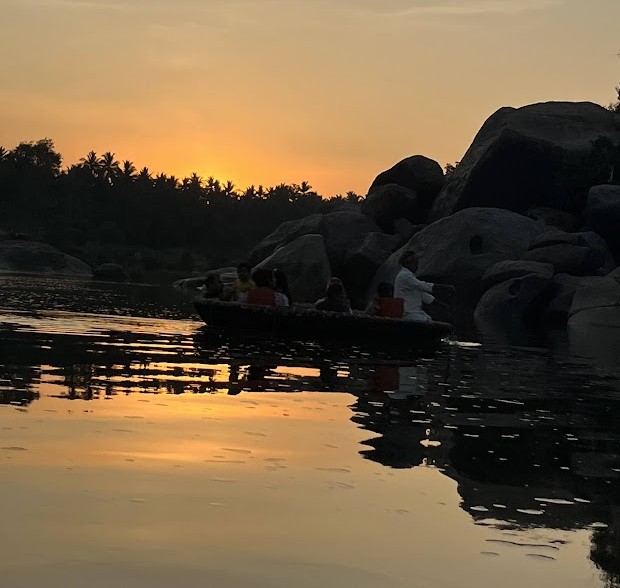
Our last adventure in Hampi during the day was coracle ride. Coracle is a round boat made up of wickerwork and coated from outside with water resistant material and propelled with paddle. It is a traditional way people used to ferry across the waters. It can accommodate 5-8 people at a time. Getting in to the 
boat is really tricky but with the help of oarsman we managed.

It was a unique experience as the boat goes round and round while moving forward. The oarsman gave us experience of merry-go-round by rotating to coracle around its axis .
The evening sun was spreading the glow on quite waters and we were the only people in the river. Ruins of ancient Hampi were all around us on the banks of the river Tungabhadra. The setting sun, evening glow on water, gently flowing waters and increasing shadows of the hillocks on the banks had serene, calming effect on all of us after a long day. 


The temples and the naturally balancing boulders on the bank with Virupaksha bazaar spreading across the bank was an amazing site. 


The sun set was the most befitting conclusion of the day. 


Tomorrow morning we will be leaving for Hubbali on our return journey to Mumbai. On our way back there are two more attractions. More about them in my next and last blog.