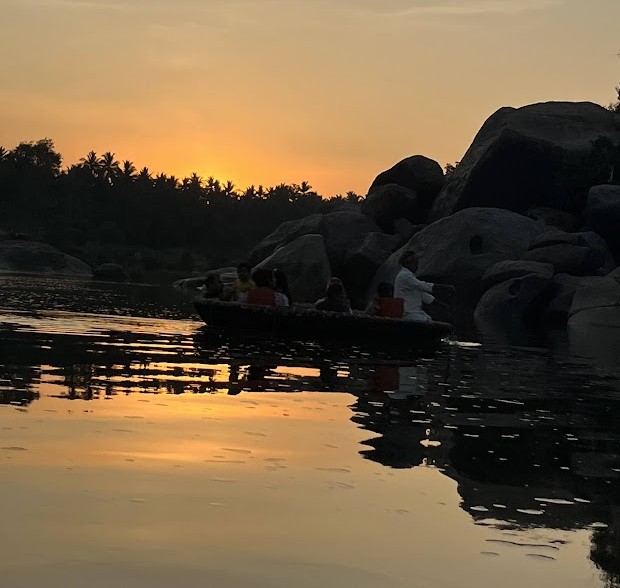
Music in Stones!
We were staying in a Home Stay
near "New Hampi". New Hampi refers to a resettlement area, or a new town, built to accommodate people displaced from the ancient city of
Hampi, a UNESCO World Heritage site, which is also known as the capital of the
Vijayanagara Empire. Shri. Nagaraj, our guide for our Hampi tour arrived on time to take us on our trip to
Hampi – Day -1.
As we boarded the bus our guide started his fluent commentary on the history of Vijayanagar. He was pointing out landmarks as we were passing them. On the way from our
place of stay to Vitthal temple we passed by the Kamalapur Lake. Kamalapur
Lake, is a man-made reservoir in Hampi. Kamalapur lake was highly significant part
of the Vijayanagar Empire's water management system. The water was used for
irrigation and potentially supplying (using earthen pipes) to the "Royal Centre".
This was found from the records written by Italian traveler Niccolò de' Conti
who visited Hampi in 1420 AD.
The landscape is typically
hilly terrain characterised by granite boulders in all shapes and sizes, scattered all around. The granite bedrock has weathered and eroded over
millions of years, along cracks and crevices, resulting in the distinctive
boulder-strewn landscape. The granitic boulders are primarily igneous rocks.
The landscape is also frequented by inselberg, meaning island mountain in
German. These are isolated hills butting out on planes or otherwise levelled
surfaces. They are formed due to erosion of the surrounding material. The
varied shapes and formations are the Nature’s sculptures, hinting tourists about
the manmade marvels awaiting them ahead.
Hampi was not the original
name of the place. Pampa is the name of the river Tungbhadra and the place
located on the Banks of the river Pampa was Pampapura, Pampakshetra meaning
land of Pampa. Hampi is the anglicised version of Kannada Hampe (derived from
Pampa). The mythological story is very
interesting. In Satyuga, Shiva’s wife Sati died and Shiva was unable to bare
the grief and left Kailash, renounced the world and sat for meditation on
Hemkuta Parvat (mountain). Demons and Asuras realised that Shiva was not around and
started harassing Devas. All the gods went to Brahma and requested him to interfere.
Brahma told them "destruction is job of Shiva you wake him from his deep
penance, meditation and he will do the needful." No one was ready to disturb
Shiva and attract his wrath. Kamadeva and Rati came forward and took the task.
Together they perform kamkrida (erotic dance) to disturb Shiva. Angry Shiva
opened his third eye and burnt Kamdeva on the spot. Hence, the temple of
Virupaksha (Virup – angry and Aksha is eye or Netra), it is temple of angry
Shiva hence the entrance to the temple for the devotees is from the side and
not from the front, which is overseen by third eye of Shiva. More when we visit
Virupaksha.
Sati / Parvati now in the form
of Pampa devi who was undergoing rigorous penance with devotion to win Shiva as
her husband, on the other bank of Pampa. Parvati demonstrating unwavering
dedication, ultimately won Shiva, he was pleased and agreed to marry Parvati or
Pampa Devi. From then on, she is considered as consort of Virupaksha.
A quick run through of
Vijayanagar history. According to the narrative, Vijayanagar founder brothers
Harihara (Hakka-I) and Bukka Ray (Bukka-I) belong to Kakatiya dynasty and
served as Kampili Chiefs. After king of Warangal (Kakatiya) was defeated by
Muhammad Bin Tughlaq and Kampili failed, his commanders Harihara (Hakka-I) and
Bukka Ray (Bukka-I) were taken prisoners to Delhi. There, they were forced to
convert to Islam. After some years both were sent back to Kampili as
subordinates of Sultanate of Delhi. There they met Vidyaranya Jagatguru (World spiritual teacher) from
Sringeri Sharada Peetham. He converted them back as Hindus and guided them to
establish Vijayanagar in 1336. From 1336 to 1565 approx. 230 years, four
dynasties ruled from Vijayanagar. The first being Sangama, followed by Suluva,
Tuluva and Aravindu. Krushnadev Raya belong to Tuluva dynasty. In 1565 Vijayanagar was defeated by coalition
of Muslim Sultanate and Hampi, capital of Vijayanagar was plundered, looted,
and destroyed. From then on Hampi was called as “City of Ruins” or the “Lost
City.” Vijayanagar had 7 fortification walls and 24 gates. Most of them are
destroyed but the fortifications are visible in parts when going around in the
city.
Hampi is surrounded by hills, tallest amongst them is Matanga. Matanga is the hill where Shri. Ramchandra
killed Vali and gave Sugriva his Kingdom and set free his wife Ruma. Hemakuta
is known for its sunrise and sunset points and the group of temples, Anjanadri
considered as a birth place of Hanumana. It is also known as Kishkindha. This was
where Sugriva and Shri. Ramchandra met. Shabari cave near Pampa Lake was the place
where Shri. Ramchandra met Shabari and she told him to meet Sugriva. Shri.
Nagaraj finished his narration as we reached the entrance of Shree Vijaya
Vitthal temple.
 As
we were approaching the temple Gopuram, serving as a gateway between earthly
and divine realms, on the right-hand side there was line of granite pillars on
the granite plinth more than a meter tall and covered with similar slabs as a
roof. They were akin to multiple stalls and indeed that was a market (Bazaar) place. Added multiple photos just to give idea of the spread of the market. The
place was Vitthal Bazaar out of the seven bazaars in Hampi.
As
we were approaching the temple Gopuram, serving as a gateway between earthly
and divine realms, on the right-hand side there was line of granite pillars on
the granite plinth more than a meter tall and covered with similar slabs as a
roof. They were akin to multiple stalls and indeed that was a market (Bazaar) place. Added multiple photos just to give idea of the spread of the market. The
place was Vitthal Bazaar out of the seven bazaars in Hampi.
a(
This was Vitthal Bazaar famous
for trading of horses (in true sense of the word) and Elephants. Horses were
brought in from Arabia, Mongolia, Persia, and Europe to be sold here. Elephants
were coming from Sri Lanka to be sold here. On the friezes below the plinth of
Vitthal temple one can see traders checking horses. One counting teeth to know
horse age, another measuring length of the tail to know of it can run faster (short tailed run faster) and yet another showing how long horse can jump. Followed by Elephants friezes.
On the lighter note, the word market may have originated from the Kannada word “Marukatte – maaru
-to sell and katte – platform or place.” Though the recorded origin is from
Latin word “Mercatus,” “Merx” meaning merchandise.
At
the other end of the approach road was Gopuram. Gopuram the hall mark of South
Indian style of architecture. Many a time the entrance of the temple shrine is
far more intricate and beautiful than the Garbhagriha. Closer inspection
revealed that the base part of the structure was made up of stone and as we go up earthen
bricks were used. The binding material then used as informed, consisted of lime
mortar (lime, sand and water mixed), egg shell, jaggery molasses, Olivera jell
and coconut water. Nagaraj educated us. An attempt was made to restore the
gopuram from an old photograph by the authorities using similar materials.

After the Vitthal idol was
removed, Krishnadev Raya placed idol of Tirupati Balaji (he was devotee of
Tirupati). The one which was destroyed by the subsequent Muslim invasions. The temple was built around the idols
accompanied by later addition by the king and his queens of multiple mandapas
such as Bhajan Mandapam, Kalyan Mandapam (Wedding Hall), Maha Mandapam (or
Sabha Mandapam) also known as Sangeet Mandapam.
On the left of the entry from Gopuram one can
see the Kitchen, Dormitories or Dharmshala for pilgrims visiting the Shrine, not seen in this picture. Seen in the picture are Vitthal Temple, Maha Mandapam or Sangeet Mandapam and Garuda Rath, the chariot.
Krushnadevaraya had three
wives Trunamula Devi, Chenna Devi and relatively less known Anpurna Devi.
Chenna Devi was a classical dancer and had wish to offer her services to the
temple. The Maha Mandapam or Sangeet Mandapam was created for the purpose.
It is
an Architect’s marvel. There are 56 pillars which are monolith each having
multiple columns of varied sizes, height, design and diameter. The number of
columns in each pillar are different. In some pillars number of columns is as
high as 16 and some it is just 7. Each column has apparently different metallic
composition and hence resonated at different frequencies when hit by wooden
sticks. In brief each pillar was able to create sound of different musical
instruments and can be played to accompany queen while she is dancing. This
picture with multiple angles gives some idea of the intricacy, complexity
and the beauty of the design. The architect not only
knew work but also understood metallurgy, music and musical instruments.

The authorities
have now restricted access to the Sangeet Mandapam for the obvious reason that
visitors may try their hands on these pillars, which may cause permanent damage to this
marvel. Thanks to innovative thinking by Archaeological Survey of India, Hampi
Circle, technology has helped on this front and tourists can get near real experience
of the musical notes, which could be heard from respective pillars by scanning the
QR codes provided near each pillar. Jagate is a round, metal percussion instrument used in Indian temples to announce the arrival of deities and in street processions.
Kalyan Mandapam the marriage
celebration hall is another mandapam, which you should not miss. This is equally
interesting as the temple and the Sangeet Mandapam. It is an open pavilion with
32 pillars and the pillars are decorated by carvings from Ramayana.


Mythological
creatures are carved on the length of the stone pillars. These creatures are
combination of Elephant, Horse, Lion and Crocodile face with a trunk and man
riding it.
The creature is called as Yali. Yali is considered as protector, a
symbol of power with all the virtues of the animals combined. The aspiring king
should have all the attributes and capable of mounting the creature.
On
pillars, beautiful carvings are visible. From left corner in clock wise
direction is Hanuman giving Chudamani (crest jewel) of Seeta to Shri
Ramchandra. Next is depiction of the story behind the name “Hoysala.” The word
Hoysala refers to the medieval dynasty that ruled in Deccan region is Southern
India. The name Hoyasala came from the man named Sala or Poysala who defended
his Jain Guru from attacking lion with a single strike (Hoy in Kannada) of his sword. Below is Nrusimha killing Hiranyakashyapu,
then is dancer and the last one is Kamadeva shooting a flower arrow with
feather bow.

The
Maha Mandapam is exactly aligned with the central axis of the temple courtyard
and it is bang in front of the stone chariot.
Seen in the picture below is Garuda Rath or the Chariot. The picture of same Chariot is appearing on the reverse of Indian currency note of ₹ 50. Hampi being a UNESCO Heritage Site.
This Chariot is symbol Krushnadev Raya’s
victory over Odisha (Orisa) after 4 years of war. He defeated Gajapati Prataprudra. He
was impressed by the Konrark Suryamandir and to celebrate his victory he created this, Garuda Rath. It is not from a single stone but 24 pieces of stone carved and assembled.
The wheels apparently use to roll, which were not fixed. The Elephants in front
of the chariot is later addition by Britishers when the horses earlier were
destroyed by invaders. Traces of vegetable colours (some patches of green) is still visible on the
chariot giving scope for tourists to imagine what it must be looking in its
glorious days.
We
walked from Vitthal Temple towards river bank. We came across multiple ruins of
the old temples and pillars with beautiful carvings, again the bottom friezes
are adorned with horses.
On the left hand side while walking towards the river
we came across King’s Balance (Tula). Tula was used by the King on auspicious
days or festive occasion to weigh himself with gold, silver or precious
stones and jewels to donate the same to needy citizens attending the festival or the
function.
As you come in the clear on
the right side a mandapa is visible with white washed top. This is known as
Purandara Dasa mandapa. Purandara
Dasa (c. 1470 – c. 1564), known as the "Pitamaha" (grandsire) of Karnatic
music, was a renowned composer, singer, and Haridasa philosopher from Karnataka, India, who lived and attained samadhi in Hampi.
His compositions and lyrics were so simple
that even children could understand them. He wrote about Vitthal Bhakti
(devotion). He is known as founder of Dasya
Sahitya. He wrote more than 50000 poems, lyrics.

This was a long pre-lunch
session and we decided to break for lunch and were looking for authentic Kannada lunch. As usual our capable guide directed us to Mango Tree Restaurant with
simple ambiance with addition of Indian sitting along with usual sitting arrangements. We had
sumptuous lunch and decided to continue our site seeing after spending some time
in restaurant’s courtyard in tree shades in the hot afternoon.
We will continue in my next
blog, post lunch on Day 1 in Hampi.