Saturday, 19 April 2025

The Ancient Ruins-Hampi-Day-2

Today we have planned to go to Anjanadri Hill (Kishkindha) in Koppal district, Taluka Gangawati in Karnataka. As told in Ramayana  Hanuman was borne on Anjanadri Hill. This is supposedly one of the many birth places of Hanuman claimed by locals in different States in India. Two others are Anjanadri Hill at Tirumala Andhra Pradesh and Anjanadri Hill near Nasik in Maharashtra.  

Kesari and Anjana were Hanuman's parents.  As the story goes, the Payasam (rice pudding) was bestowed by Agni (fire God) upon Dasharath (king of Ayodhya) during Putrakameshti Yadgna.  Dasharath was carrying Payasam to his three wives. All of a sudden a kite flew by and snatched some portion of Payasam.  At the same time, on Anjandri hill, Anjana was worshiping with open palms.  Kite while flying over dropped the Pyasam, which Vayu (wind God) carried to Anajana's open palms. Taking it as a gift of God she ate it and the resultant baby was Hanuman. Hence Vayu is considered as spiritual father of Hanuman. Vayu also symbolises strength and speed, which Hanuman is known for.

We started at around 6 am. We had to climb 575 steps to reach the top. Nagaraj smart and prompt as usual suggested that if we are ready to follow him there is other route to the top. The route had lesser steps and gradual climb connecting sets of steps. As the average age of our group members was 65+years we chose to trust Nagaraj and followed him. He was so gracious that he promised us that he will be with the last person in the group reaching the top and he kept his promise.  

The climb was steep, it took us approx. 1hr 15 mins. Morning climate was pleasant with refreshing cool breeze that made it simpler than it looked. Sun rise was a amazing view with birds chirping around. The view was breath taking. Way below in the valley we could see lush green paddy fields, coconut trees and reflections of these tall palms in the water around.
The temple is very small and humble not like any of the marvels we had seen so far.

Being a hill top there are quite a few monkeys around. They are not harmful or trouble makers unless you have some eatables in your hands or water bottles. I happened to have one in my backpack with its cap visible from slightly open zip of the bag. I felt something on my back, before I could react small one opened the zip and took the water bottle. I tried to hold and pull back the bottle but it threatened me showing all its yellow teeth and I had to give up. These are all rhesus monkeys and they are regularly fed by the temple care takers. Apparently we had chosen right time and there was hardly any crowd in the temple.  

We had to wait for few minutes in the queue for darshan (to see the Hanuman idol) . We had nice darshan without crowd pushing or volunteers asking us to hurry up (common site in most of the popular places of worship). Going ahead there are idols of Sri Ram, Laxman, Sita. Next to these idols there is glass tank half filled with water and a black stone floating in the water with board reading "Stone used to build Ram Setu. Weight 25kg". Ram Setu is the bridge connecting Pamban Island near Rameshwar India to Manar Island in Sri Lanka (located in Palk strait) As the mythology goes this bridge was built by Sri Ram with the help of soldiers of Sugriva the monkey king. Next is idol of Anjana, mother of Hanuman. 

Plateau on which the temple is located is large and is overlooking the beautiful green valley below. The view from the top took away all the fatigue we had and we were fresh and decided to climb down from the official path. Water of Tungabhadra was visible at distance as a molten silver. Water inundated paddy fields were sparkling in the morning Sun and the greenery and calming cool had effect on all of us. 

We came across large crowd of devotees reciting Hanuman Chalisa, some were giving slogans Jay Sri Ram, Bajarangbali (another name for Hanuman) ki Jay (loosely translated victory to Sri Ram, Hanuman) while climbing and atmosphere was suddenly devotional. Individuals feel a sense of peace and connection. 

We reached the bottom of the hill and every body realised how hungry we were and rushed for the breakfast. All of us relished steaming idali, wada, dosai with hot sambar and green chatani, followed by coffee in  a road side restaurant. Our next destination was Virupaksha temple. 

On the way to Virupaksha temple, which is 7th century Shiva temple you can see Virupaksha bazaar  on the either sides of the road.

The multistoried shops in a row are spread more than 950 meters, little less than one kilometer parallel to the road. This was supposed to be one of the largest and most vibrant bazaar all across 7 bazaars in Vijayanagara. This was the place where gems, diamonds and other precious stones, pedigree horses from various countries, Spices, silk, rich textile, and elephants from Sri Lanka were coming for sale. These shops were used by more than 328 families as their homes as recently as 2011 when ASI with the help of Karnataka High Court took out the eviction order and relocated families in New Hampi.  

Three dynasties had contributed to building of this temple viz. Hoysala, Chalukya and Tuluva (Krushnadevaraya). The swayambhu (self-manifested) lingam dates back to Satyuga. As the story goes, when Shiva disappeared after marriage with Pampa devi (Parvati in her later form) he appeared here as a  lingam. The story further narrates that Sri Rama when staying here (during Chaturmas) worshiped this lingam. 


As we walked from bazaar towards the temple, one can't take his eyes off the one of the tallest Gopurams (165 ft, 11 storied) built by Krushnadevaraya. It is Raj Gopuram i.e. main gopuram or Eastern Gopuram.   


Walking towards the garbhagriha with Raj Gopuram behind our back, two other  smaller gopurams are seen located on inner East and inner North East side. In the compound  we came across three headed Nandi. One body three heads, possibly the only statue in India. The earlier place of Nandi was on Nandi Pitham located in front of the lingam. But like all other sculptures it was destroyed by invaders and was moved out from regular worship. 
 

As the deity is Swayambhu Lingam even today Trikal-Pooja (three times worship), Trikal-Abhishekam (Abhishekam-liquid offerings are poured over the deity) and Trikal-Naivedyam (Naivdedyam -Pasad or food offering) are followed during the day. Hence the three headed Nandi. 

The name Virupaksha (Virupa is angry look, Aksha is eye)  means Shiva's angry manifestation. Shiva burnt Kamadeva and his wife Rati for disturbing his meditation on Himkuta Paravat (mountain) after Sati's death (Parvati in her earlier Avatara), the detailed story is in my earlier blog.  Hence this is possibly the only temple where devotees enter from the side of the Garbhagriha rather than from the front facing Shiva. The lingam is decorated with flowers, silver mask and Gold mukutam (crown) which is used on major occasions such as Shivaratri or Virpaksha procession. The crown is 5.5 kgs of gold donated by Krishnadevaraya.  On Shiva's forehead instead of three stripes of Bhasma, sandal wood paste is applied to keep him cool. 


The temple compound has Dharmasala on the right and Nandipith (Original place of three headed Nandi), Flag post, Naivedyapith and lamp post on the way to garbhagriha. 
The main pillared sabhamandap, has a ceiling with murals painted more than 500 years ago. The colours used are still visible. This is the place where one can see painting of chaturmukha Brahma (Brahma with four faces), the paintings include, Girijakalyan (marriage of Shiva and Pampa(Parvati)), Draupadi Swayamvar, Procession of Vidyaranya, Tripurasura Samharam (with Shiva on chariot with Sun and Moon as Chariot's wheels, Earth as the floor, Panch maha bhuta as the horses), Brahma, Vishnu and Mahesh (Shiva), Guardians of eight direction (Ashta Dikpal), Dashsavatar of Vishnu and so on. In fact today I felt sorry as I didn't have proper camera to capture the beauty of these paintings. 


The first row shows from left to right Vishnu, Shiva and Brahma and Kamdeva is seen on chariot with his feather bow and flower arrow in another picture, on the right are seen Dikpals.  These photos may not give clear idea of how beautiful they are. The sculptures on the side walls are also seen.


Last but not the least of the wonders is a natural pin hole camera which provides inverted image of the Raj gopuram inside the temple. If this is not natural and man made then one wonders about the knowledge of our ancestors (documented use of Pinhole camera is in sixteenth century). 

We took blessings from the Laxmi female temple elephant before leaving the temple. (One has to offer 10 rupee note to get the blessings!). 

Our next stop was Idagunji Maha or Kadalekalu Ganesha or Chana Ganapati. The name comes from the shape of the belly which looks like Chickpea (Chana) or Kadale in Kannada. The idol was carved from a single rock, monolithic. The temple was built around the idol after carving it from single stone. The Ganesha temple was built in 1428 by Praudhadevaraya from Sangama dynasty and the 24 pillar sabhamandapam or mahamandapam was built subsequently by Krishnadevaraya. Before visiting Virupaksaha temple royal family used to visit Idagunji Maha. 


Despite the defacement by the invaders one can see the beauty of the carving particularly in pash, ankush, lines on the palm, finger nails, and folds on Modak (the favourite food of Lord Ganesha). 24 pillars in the mahamandapam carry sculptures.

Then artists must have taken inspiration from the travelers who visited Hampi in those days. From the sculptures we can make out Mongolian, Egyptian and Chinese travelers.  
Next we visited Laxmi Narsimha and Badvi Linga as the statues are close by. 
The huge monolithic sculpture of Lakshmi Narasimha is one of the most outstanding works of sculptural art of Vijayanagara. This statue stands to a height of 6.70 m. consecrated by priest Krishna Bhatta at the behest of Krishnadevaraya in 1528 CE as per Lithic record. Narasimha, fourth incarnation of Lord Vishnu, is found seated in yogic posture with yogapatta on the giant coils of Adishesha, the sacred guardian snake of Vishnu. 
The figure of Narasimha is set within an architectural frame consisting of seated lions at the base, half pilasters with creeper motif, double Kirtimukha rising curved capitals and makaras on the sides, and a foliated frame topped with a Kirtimukha over the seven-hooded Naga on top. The four arms of the statue with their various attributes have been broken. The seated figure of his consort Lakshmi on his left lap is missing. The face too has been damaged which misled people into believing that it was the Ugra Narasimha (ferocious Narasimha). But the presence of the right hand of the goddess embracing the Lord at the back is the proof of it being that of Lakshmi Narasimha.


The Badavi Linga, a monolithic Shiva Linga in Hampi, Karnataka, stands at a height of approximately 3 meters (10 feet). It is known as the largest Shiva Linga in Hampi and is housed within a small stone chamber. The Linga is carved from black rock and has three eyes etched on its surface.
If you zoom in, third eye of Shiva is visible. Badava in Kannada means a person with a few or no possessions. 
Legend has it that this was commissioned by a peasant woman and hence the name by saving for the life time to build this lingam. It is believed to be built in 15th Century.  
The sanctum in which the Linga is installed is always filled with water as a water channel is made to flow through it.

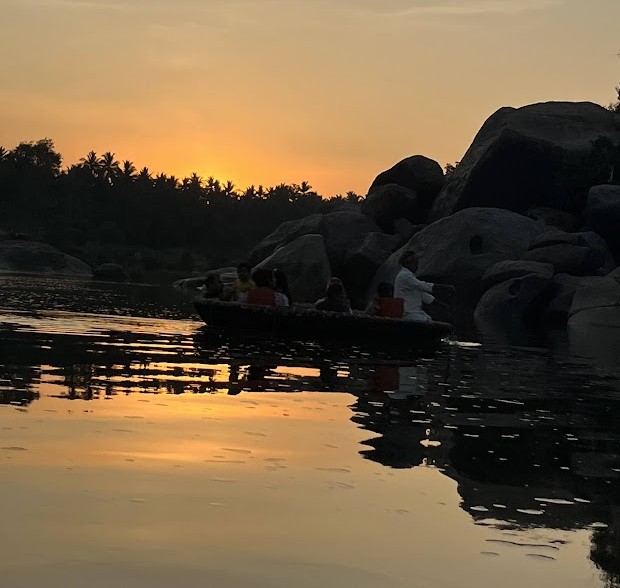
Our last adventure in Hampi during the day was coracle ride. Coracle is a round boat made up of wickerwork and coated from outside with water resistant material and propelled with paddle. It is a traditional way people used to ferry across the waters. It can accommodate 5-8 people at a time. Getting in to the 
boat is really tricky but with the help of oarsman we managed.

It was a unique experience as the boat goes round and round while moving forward. The oarsman gave us experience of merry-go-round by rotating to coracle around its axis .
The evening sun was spreading the glow on quite waters and we were the only people in the river. Ruins of ancient Hampi were all around us on the banks of the river Tungabhadra. The setting sun, evening glow on water, gently flowing waters and increasing shadows of the hillocks on the banks had serene, calming effect on all of us after a long day. 


The temples and the naturally balancing boulders on the bank with Virupaksha bazaar spreading across the bank was an amazing site. 


The sun set was the most befitting conclusion of the day. 

Tomorrow morning we will be leaving for Hubbali on our return journey to Mumbai. On our way back there are two more attractions. More about them in my next and last blog. 


Saturday, 12 April 2025

The Ancient Ruins: Hampi Day-1

Post lunch on Day - 1 
As the afternoon heat eased up a little, we proceeded to Palace ground, the area is more than 600 acers. Palace grounds once had number of Royal buildings. Queens' palace, Lotus palace, Jal mahal, Queen's bath, Treasury building etc.  

First we visited queen's bath. The bath is like a swimming pool with depth of around 1.8 meters. The water source was Kamalapur lake, I wrote about in my earlier blog. The underground aqua ducts or earther pipes (none are visible now) use to bring water to queen's bath (inlet for the water is seen). There must have been level difference between source of the water and the queen's bath for water to flow under gravity to the bath. In order to filter the water before queens could use it, water from the lake was collected in a moat with thick layer of sand. Water accumulated in the moat used to percolate through the sand as a filter and reach the bathing tank. Water drain is also visible. The bathing pool is surrounded by galleries where musicians and dancers or court artists could perform to entertain queens while they are having good time. The first floor is pavilions for queens to relax and enjoy outside view.  

There are 24 domes in queen's bath. They were decorated with flora, fauna (birds) designs. The Indo-Islamic architecture is clearly visible from the design of arches at various places. The arches are seen every where in queen's bath. In four corners one can see holes which may have been there to have pillars to support wooden roof. The Indo-Islamic style of architecture can be the reason for surviving of queens bath from the invaders' onslaught. Inside of few domes.
From Queen's bath we moved on to the palace ground. The ground is surrounded by a thick stone wall, may be 8-10 feet in height, and crumbled in places. The wall is gradually tapering from bottom to top, possibly to make it self supporting structure as we don't see in between pillars. On the left side of the entrance one of the three watch towers is seen. 

These watch towers were used by the security guards to protect palace grounds. Incidentally the treasury building was also in the same compound. The house like structure seen behind the tree in the left corner of the picture is the place where treasury building  used to be.  
The other two watch towers are also visible as you proceed further towards Queens' palace (Krushnadevaraya had 3 queens) or rather plinth of the Queens' palace. One of them is overlooking Queens' palace. The guards were predominantly transgenders who were employed to protect Krushnadevaraya's janan khana (queens' residence or enclosure).

The plinth of the Queens' palace gives fair idea of the majestic, grand royal structure once stood there. From the description of the travelers back then, who were in large numbers, Hampi being a trade center, helped artists to paint the picture of the palace. Our guide had album of all such paintings and felt proud while  showing them along with his commentary. The palace was a wooden structure made up entirely  of sandal wood with gold and silver used for moldings. The precious stones where used for decorative knobs and handles. Silk, rich textile and fabric served to heightened the grandeur of the place, reflecting splendor and power of the king. 
The palace being a wooden structure it was far more easier for the invaders to destroy it completely after looting the valuables. While wondering how the carpentry work would have been on sandal wood pillars,  roof, windows and door frames we were approaching another architectural marvel Lotus Mahal (palace). On the way to our right we could see the ruins (or rather the place) of another mahal known as Jal mahal, possibly a pool. Jal mahal was used by Queens whenever King was out of the palace as the Queen's bath is outside the guarded palace ground. 
The Lotus mahal  was the summer abode for the royal family. The construction is in typical Indo-Islamic style.  The curves of the building reflect Islamic influence and protects the palace from harsh weather. It is two storied structure both with arched openings in multiple planes. There are 8 (eight) pyramidal towers in all corners with one big tower in the middle of the structure, supported by 24 pillars. The pyramidal tower is influenced by Indian style of architecture.  The building has a water storage on the top and the water is circulated through terracotta pipes in the pillars with holes drilled in pipes to allow the water to sprinkle on walls and as the air passed over these walls the inner parts of the palace were cooled. On the pillars and walls stone slabs are placed to place the oil lamps at night.  
These photographs show the complexity of design and the beauty of the structure even after more than 600 years. 
We had group photo session around the Lotus Mahal (climbing or going inside the building is prohibited for obvious reasons). To our surprise, Nagaraj our guide turned out to be a skilled photographer with unique ability to see the world through a creative lens and capture angles, which others may simply miss. 
The next destination was Elephants' stable (Gaj Shala). 

As we walked towards the stable trying to imagine the size of the stable of Elephants, at a far distance on top of the boulders we saw sentry point overlooking the palace ground. Obvious question was how sentry would spot enemy approaching the palace from such a distance and at night in particular. The technique was quite innovative. Multi-pronged thorns prepared by village blacksmiths were  buried under thin layer of soil with one or more spikes pointing upwards. After the trap  thick layer of dry fine white ash was spread. As the intruder(s) (who will be unaware of such traps) steps on the thorns his immediate reaction would be to jump and try to get away from the pain. His efforts will ruffle the ash, ballooning in a white cloud, which can be seen even in night light from a distance and action started. 


As we came close to the elephant stable,  what we saw was amazing. The building was massive and could accommodate 11 elephants. The architecture is of mixed style. Some of the 10 domes display Islamic influence, others are in Buddhist style finding resemblance to Stupa or Vihara and the central Shikhar is in Indian style, which is mostly destroyed. Adoption of such styles of architecture indicates secular, tolerant, forbearing approach of the then rulers towards all the religions. 
These elephants were royal elephants and not the army elephants. Elephants were used in festival processions such as Dusshera procession, Jambu sawari and other Royal occasions.  These elephants would carry gold ambari ( The "ambari" is a howdah on the back of the elephant for royal riders) weighting more than 250kgs. On 9 elephants will be placed Navdurgas (Shailputri, Brahmacharini, Chandraghanta, Kushmanda, Skandamata, Katyayani, Kalaratri, Mahagauri, and Siddhidhatri), on 10th will be placed Bhuvanesvari family deity of Krushnadevaray and the Royal family will mount on the last elephant. 
The stables are West facing to ensure cooler air in summer to maintain the temperature in the stables. The domes had another purpose. The height of the domes offered better ventilation keeping gaj shala cool.  Whenever elephants used to be in musth it would start trumpeting loudly and become aggressive. The trumpeting noise will echo in the domes and sound much louder to the elephant, effectively calming them.  


In order to mount and unmount the elephants royal family required a platform, the same was provided near the elephant stable. It is worth watching how well it was designed and beautified, with pavilions below to  wait for or relax after the ride. 
The ground around the stable was used as a training ground for soldiers. Compound wall carries some indicative carvings one showing direction of water source by a fish and two sparing soldiers as if being trained. 
We had to decide where to go next, one of the  option was Hazara Rama mandir (Hazara - thousand) and another was Malyavanta Raghunath temple or Malayavant Raghunath Swami temple. 


We decided on Hazara Rama mandir. This was a Royal temple, built by Royal family. Dedicated for worshiping and festivities by the Royal family members. 
The temple was built in early 15th century by Krushnadevaraya and was very simple with garbhagriha and ardh sabhamandap.  The temple wall has band of panels in three rows. Each panel has incidents from Ramayana carved on them in chronological order of events.  If someone  circumambulates the temple three times in clockwise direction he would witness entire Ramayana on the temple walls. 


Unfortunately, we were so engrossed in watching the temple and listening to the Ramayana from Nagaraj that not many photos were taken except few carvings on the pillars of the temple. 
Sculptures of Sri Ram, Laxman and Sita with Hanumana, Krishna in the form of Bal Krishna, Murali Krishna are seen carved on the pillars in the picture.


The compound walls are beautifully carved again in multiple bands of panels holding sculptures of dancers, musicians, elephants, camels and horses. 


From there we moved on to the Malayavant Raghunath temple. The temple is located on Malayavant Paravat (Mountain)


This is probably the only temple where Sri Ram is seen in sitting posture. As the story goes. Sri Ram on his way to Sri Lanka stayed here during rainy season, chaturmasa (4 months period of Vedic calendar  that is considered auspicious for spiritual practices, fasting, and devotion). 
This was the place where Hnumana brought chudamani (crest jewel) of Sita after paying visit to her in Ashok Vatika in Sri Lanka and gave it to Sri Ram.  

We walked behind the temple to reach the top of the mountain from where we could witness beautiful Sun set on the Vijayanagara Empire to end the memorable day 1 at Hampi.


Tomorrow morning we are planning to visit Anjaneyadri Hill located near Hampi, is believed to be birth place of Hanuman also known as Anjaneya. There is Hanuman temple on the top. To reach the top one has to climb 575 steps. We will start at 6 am tomorrow. More in my next blog. 


Monday, 31 March 2025

The Ancient Ruins: Hampi-Day-1


Music in Stones!

We were staying in a Home Stay near "New Hampi". New Hampi refers to a resettlement area, or a new town, built to accommodate people displaced from the ancient city of Hampi, a UNESCO World Heritage site, which is also known as the capital of the Vijayanagara Empire. Shri. Nagaraj, our guide for our Hampi tour arrived on time to take us on our trip to Hampi – Day -1.

As we boarded the bus our guide started his fluent commentary on the history of Vijayanagar. He was pointing out landmarks as we were passing them. On the way from our place of stay to Vitthal temple we passed by the Kamalapur Lake. Kamalapur Lake, is a man-made reservoir in Hampi. Kamalapur lake was highly significant part of the Vijayanagar Empire's water management system. The water was used for irrigation and potentially supplying (using earthen pipes) to the "Royal Centre". This was found from the records written by Italian traveler Niccolò de' Conti who visited Hampi in 1420 AD.

The landscape is typically hilly terrain characterised by granite boulders in all shapes and sizes, scattered all around. The granite bedrock has weathered and eroded over millions of years, along cracks and crevices, resulting in the distinctive boulder-strewn landscape. The granitic boulders are primarily igneous rocks. The landscape is also frequented by inselberg, meaning island mountain in German. These are isolated hills butting out on planes or otherwise levelled surfaces. They are formed due to erosion of the surrounding material. The varied shapes and formations are the Nature’s sculptures, hinting tourists about the manmade marvels awaiting them ahead.

Hampi was not the original name of the place. Pampa is the name of the river Tungbhadra and the place located on the Banks of the river Pampa was Pampapura, Pampakshetra meaning land of Pampa. Hampi is the anglicised version of Kannada Hampe (derived from Pampa).  The mythological story is very interesting. In Satyuga, Shiva’s wife Sati died and Shiva was unable to bare the grief and left Kailash, renounced the world and sat for meditation on Hemkuta Parvat (mountain). Demons and Asuras realised that Shiva was not around and started harassing Devas. All the gods went to Brahma and requested him to interfere. Brahma told them "destruction is job of Shiva you wake him from his deep penance, meditation and he will do the needful." No one was ready to disturb Shiva and attract his wrath. Kamadeva and Rati came forward and took the task. Together they perform kamkrida (erotic dance) to disturb Shiva. Angry Shiva opened his third eye and burnt Kamdeva on the spot. Hence, the temple of Virupaksha (Virup – angry and Aksha is eye or Netra), it is temple of angry Shiva hence the entrance to the temple for the devotees is from the side and not from the front, which is overseen by third eye of Shiva. More when we visit Virupaksha. 

Sati / Parvati now in the form of Pampa devi who was undergoing rigorous penance with devotion to win Shiva as her husband, on the other bank of Pampa. Parvati demonstrating unwavering dedication, ultimately won Shiva, he was pleased and agreed to marry Parvati or Pampa Devi. From then on, she is considered as consort of Virupaksha. 

A quick run through of Vijayanagar history. According to the narrative, Vijayanagar founder brothers Harihara (Hakka-I) and Bukka Ray (Bukka-I) belong to Kakatiya dynasty and served as Kampili Chiefs. After king of Warangal (Kakatiya) was defeated by Muhammad Bin Tughlaq and Kampili failed, his commanders Harihara (Hakka-I) and Bukka Ray (Bukka-I) were taken prisoners to Delhi. There, they were forced to convert to Islam. After some years both were sent back to Kampili as subordinates of Sultanate of Delhi. There they met Vidyaranya Jagatguru (World spiritual teacher) from Sringeri Sharada Peetham. He converted them back as Hindus and guided them to establish Vijayanagar in 1336. From 1336 to 1565 approx. 230 years, four dynasties ruled from Vijayanagar. The first being Sangama, followed by Suluva, Tuluva and Aravindu. Krushnadev Raya belong to Tuluva dynasty.  In 1565 Vijayanagar was defeated by coalition of Muslim Sultanate and Hampi, capital of Vijayanagar was plundered, looted, and destroyed. From then on Hampi was called as “City of Ruins” or the “Lost City.” Vijayanagar had 7 fortification walls and 24 gates. Most of them are destroyed but the fortifications are visible in parts when going around in the city.

Hampi is surrounded by hills, tallest amongst them is Matanga. Matanga is the hill where Shri. Ramchandra killed Vali and gave Sugriva his Kingdom and set free his wife Ruma. Hemakuta is known for its sunrise and sunset points and the group of temples, Anjanadri considered as a birth place of Hanumana. It is also known as Kishkindha. This was where Sugriva and Shri. Ramchandra met. Shabari cave near Pampa Lake was the place where Shri. Ramchandra met Shabari and she told him to meet Sugriva. Shri. Nagaraj finished his narration as we reached the entrance of Shree Vijaya Vitthal temple. 

As we were approaching the temple Gopuram, serving as a gateway between earthly and divine realms, on the right-hand side there was line of granite pillars on the granite plinth more than a meter tall and covered with similar slabs as a roof. They were akin to multiple stalls and indeed that was a market (Bazaar) place. Added multiple photos just to give idea of the spread of the market. The place was Vitthal Bazaar out of the seven bazaars in Hampi.

a(

This was Vitthal Bazaar famous for trading of horses (in true sense of the word) and Elephants. Horses were brought in from Arabia, Mongolia, Persia, and Europe to be sold here. Elephants were coming from Sri Lanka to be sold here. On the friezes below the plinth of Vitthal temple one can see traders checking horses. One counting teeth to know horse age, another measuring length of the tail to know of it can run faster (short tailed run faster) and yet another showing how long horse can jump. Followed by Elephants friezes.


On the lighter note, the word market may have originated from the Kannada word “Marukatte – maaru -to sell and katte – platform or place.” Though the recorded origin is from Latin word “Mercatus,” “Merx” meaning merchandise.  

At the other end of the approach road was Gopuram. Gopuram the hall mark of South Indian style of architecture. Many a time the entrance of the temple shrine is far more intricate and beautiful than the Garbhagriha. Closer inspection revealed that the base part of the structure was made up of stone and as we go up earthen bricks were used. The binding material then used as informed, consisted of lime mortar (lime, sand and water mixed), egg shell, jaggery molasses, Olivera jell and coconut water. Nagaraj educated us. An attempt was made to restore the gopuram from an old photograph by the authorities using similar materials.

The story behind Vitthal temple is very interesting. In 1435 when Vitthal temple in Pandharpur was threatened by Muslim invaders, (Ahmednagar Sultan) the Vitthal idol was removed by the priest from the shrine and taken to Vijayanagar for the safe keeping as that was the only Hindu empire, under Krushnadevaraya. The idol was taken back to Pandharpur around 1519 by Bhanudas. May be the reason, why Vitthal in Maharashtra got the name Kanada Vitthal due to this journey to Karnataka. 

After the Vitthal idol was removed, Krishnadev Raya placed idol of Tirupati Balaji (he was devotee of Tirupati). The one which was destroyed by the subsequent Muslim invasions.  The temple was built around the idols accompanied by later addition by the king and his queens of multiple mandapas such as Bhajan Mandapam, Kalyan Mandapam (Wedding Hall), Maha Mandapam (or Sabha Mandapam) also known as Sangeet Mandapam.

On the left of the entry from Gopuram one can see the Kitchen, Dormitories or Dharmshala for pilgrims visiting the Shrine, not seen in this picture.  Seen in the picture are Vitthal Temple, Maha Mandapam or Sangeet Mandapam and Garuda Rath, the chariot.

Krushnadevaraya had three wives Trunamula Devi, Chenna Devi and relatively less known Anpurna Devi. Chenna Devi was a classical dancer and had wish to offer her services to the temple. The Maha Mandapam or Sangeet Mandapam was created for the purpose.

It is an Architect’s marvel. There are 56 pillars which are monolith each having multiple columns of varied sizes, height, design and diameter. The number of columns in each pillar are different. In some pillars number of columns is as high as 16 and some it is just 7. Each column has apparently different metallic composition and hence resonated at different frequencies when hit by wooden sticks. In brief each pillar was able to create sound of different musical instruments and can be played to accompany queen while she is dancing.   This picture with multiple angles gives some idea of the intricacy, complexity and the beauty of the design. The architect not only knew work but also understood metallurgy, music and musical instruments. 

The authorities have now restricted access to the Sangeet Mandapam for the obvious reason that visitors may try their hands on these pillars, which may cause permanent damage to this marvel. Thanks to innovative thinking by Archaeological Survey of India, Hampi Circle, technology has helped on this front and tourists can get near real experience of the musical notes, which could be heard from respective pillars by scanning the QR codes provided near each pillar. Jagate is a round, metal percussion instrument used in Indian temples to announce the arrival of deities and in street processions. 


Kalyan Mandapam the marriage celebration hall is another mandapam, which you should not miss. This is equally interesting as the temple and the Sangeet Mandapam. It is an open pavilion with 32 pillars and the pillars are decorated by carvings from Ramayana.


Mythological creatures are carved on the length of the stone pillars. These creatures are combination of Elephant, Horse, Lion and Crocodile face with a trunk and man riding it. 
The creature is called as Yali. Yali is considered as protector, a symbol of power with all the virtues of the animals combined. The aspiring king should have all the attributes and capable of mounting the creature. 

On pillars, beautiful carvings are visible. From left corner in clock wise direction is Hanuman giving Chudamani (crest jewel) of Seeta to Shri Ramchandra. Next is depiction of the story behind the name “Hoysala.” The word Hoysala refers to the medieval dynasty that ruled in Deccan region is Southern India. The name Hoyasala came from the man named Sala or Poysala who defended his Jain Guru from attacking lion with a single strike (Hoy in Kannada) of his sword.  Below is Nrusimha killing Hiranyakashyapu, then is dancer and the last one is Kamadeva shooting a flower arrow with feather bow.


The Maha Mandapam is exactly aligned with the central axis of the temple courtyard and it is bang in front of the stone chariot.  Seen in the picture below is Garuda Rath or the Chariot. The picture of same Chariot is appearing on
the reverse of  Indian currency note of ₹ 50. Hampi being a UNESCO Heritage Site.

This Chariot is symbol Krushnadev Raya’s victory over Odisha (Orisa) after 4 years of war. He defeated Gajapati Prataprudra. He was impressed by the Konrark Suryamandir and to celebrate his victory he created this, Garuda Rath. It is not from a single stone but 24 pieces of stone carved and assembled. The wheels apparently use to roll, which were not fixed. The Elephants in front of the chariot is later addition by Britishers when the horses earlier were destroyed by invaders. Traces of vegetable colours (some patches of green) is still visible on the chariot giving scope for tourists to imagine what it must be looking in its glorious days.


We walked from Vitthal Temple towards river bank. We came across multiple ruins of the old temples and pillars with beautiful carvings, again the bottom friezes are adorned with horses. 


On the left hand side while walking towards the river we came across King’s Balance (Tula). Tula was used by the King on auspicious days or festive occasion to weigh himself with gold, silver or precious stones and jewels to donate the same to needy citizens attending the festival or the function.
As you come in the clear on the right side a mandapa is visible with white washed top. This is known as Purandara Dasa mandapa. Purandara Dasa (c. 1470 – c. 1564), known as the "Pitamaha" (grandsire) of Karnatic music, was a renowned composer, singer, and Haridasa philosopher from Karnataka, India, who lived and attained samadhi in Hampi. 

His compositions and lyrics were so simple that even children could understand them. He wrote about Vitthal Bhakti (devotion). He is known as founder of Dasya Sahitya. He wrote more than 50000 poems, lyrics.


This was a long pre-lunch session and we decided to break for lunch and were looking for authentic Kannada lunch. As usual our capable guide directed us to Mango Tree Restaurant with simple ambiance with addition of Indian sitting along with usual sitting arrangements. We had sumptuous lunch and decided to continue our site seeing after spending some time in restaurant’s courtyard in tree shades in the hot afternoon.

We will continue in my next blog, post lunch on Day 1 in Hampi.