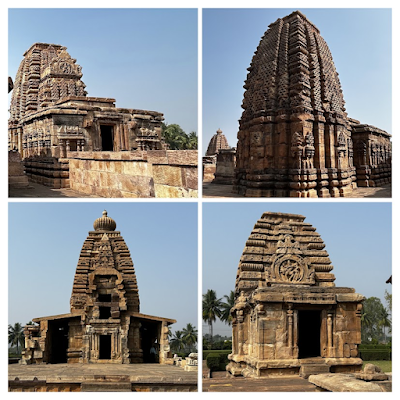
Visit to Badami Caves and Hampi was unticked in our bucket
list for quite some time. Finally, the planning for the trip began. After
taking feedback from friends and relatives who had already visited these places
and some googling, it was understood that engaging a proper guide for both the locations
was more important than arranging for the hotel accommodations or travel
bookings. Our tentative dates for the travel were in the mid of January 2025 and we
engaged guides for Badami as well as Hampi sometime in October 2024. This was
followed by our flight booking to Hubballi and arrangement of vehicle for
pickup from the Airport on arrival till our last day of the trip for the drop
off to the Airport at Hubballi.
Group of eight of us left Mumbai as planned. Our first halt
was at Badami. A place in Bagalkot district in Northen part of Karnataka. The caves are important, as the cave temples are
in rock cut architecture in line with those at Bodhgaya, Ajanta, Ellora and
Bhaja caves near Pune. We were to stay at Hotel Badami Court, which was very
close (less than 2 kms) to the location. We asked our guide Shri. Chandru
Kategari to be at the hotel by 1:30 pm. We reached Badami Caves to witness
marvels in the stone, along with him by 2 pm.
Badami Caves are cave temples carved from sedimentary rock,
sandstone, which is Badami (Badam - Almond) in colour hence the name. These are
not live temples but are declared as monuments by the Government. Warning: Do
not remove your shoes or carry water bottles or any eatables in your hand as
the place is frequented with monkeys. Monkeys are not harmful but will try to
snatch water bottles, food items or shoes.
The original name of the place was Vatapi, capital of
Chalukya Dynasty (from 6th to 8th century), ruling most
of the Karnataka. There are four caves, three of them are dedicated to Shiva
and Vishnu while one is devoted to Jainism. The exact period of these temples
is not known but the third cave has epigraphy in the Kannada language indicating
that the third cave was the last cave to be carved and it was in c. 578. The
place was crowded as devotees attending the festival of Shri Banashankari Devi in
Badami were also visiting the caves. These caves are located on the banks of
man-made lake Agastya, it has a wall (dam) around it built using the stone, cut
out during the carvings of the caves. Malprabha river flows close by (3kms).
The first cave,
numbered as 1 is dedicated to Shiva. In
plan, it comprises of an open porch and a pillared hall with a sanctuary cut
into its rear wall. On the right-hand side after climbing few steps Shiva
statue in dancing pose (Nataraj) is seen. Shiva is doing a happy dance, Sandhya
Tandava (Rudra Tandava is generally known but there are many other Tandava dance
forms like Lalit Tandava, Anand Tandava, Uma Tandava etc.)

The craftsman,
sculptor (or the artist conceptualizing the carving) had in depth knowledge of
Bharatnatyam, which was composed by Bharat Muni 2000 years ago. The carving has
18 hands, 9 on each side, which is very rare. 18 hands together form 81 mudras
(considering the permutation-combination) though, basic mudras in Bharatnatyam
are seemingly 55 only. On the right of the carving Nandi (Shiva’s transport) is
seen, and on his left is the carving of dancing Ganesh and the accompanying
Tandu (as mythology goes Brahma created Naty Veda and asked Bharata to spread
it. Tandu was Bharata’s son) playing “Tripushkar Vadya” instrument with three
faces. This is remarkable as dance cannot exist independent of music. The top
portion of the carving is damaged due to lightning.
On the opposite wall you
come across beautiful sculpture of Harihar, half Shiva and half Vishnu. Notice
crescent of moon on the right side of the head indicating him to be Shiva. On
the right of the sculpture there is Nandi (Transport of Shiva) and Parvati and
on the left side there is Garuda (Transport of Vishnu), followed by Laxmi. On
top you can see Apsara and Gandharva. They are flying, indicated by the clouds
around them (note there are no wings like angels). Below the statue you will
notice friezes of Ganas (dwarfs) carved on their pedestals. They are seen
dancing or playing instruments.
To the right of the
Harihar there is Dwarpalaka, doorman with trident in his hand, indicating him
to be Shiva guard.
Right below the guard, mirror image of the above carving is seen (this was also seen in other part of the
temple). If right side of the figure is covered, one can see Elephant and the
other half appears to be the Bull. Whether this figure had any significance or
it was show of skill is not known.

The same cave holds
sculpture of Ardhnarishvara, that is half part is Shiva and other half is
Parvati. Skeletal Bhringi Rishi is also seen in the sculpture to the right of
Shiva after Nandi and maid with jewel box is standing next to Parvati on the
left. The sculpture of skeletal Bhringi Rishi shows, how well human anatomy was
known then to the artist who carved the sculpture.

The story is very
interesting. He was ardent devotee of Shiva. As the custom goes all the
devotees who offered their homage to Shiva also offered their veneration to
Parvati. But Bhringi was an exception. He did not want even to
circumambulate Shiva with Parvati. To make Bhringi understand that Shiva
and Parvati are not two separate entities, Shiva manifested as Ardhnarishwara.
Shiva is on the right and Parvati to the left. But the Rishi took form of
Bhring (Bumbalbee) and tried to bore through Ardhnarishwara body. After his
attempt Parvati cursed him and he lost all his flesh and blood (which
supposedly mother gives her child) reducing him to a skeletal form. The
skeletal Bhringi shows that human anatomy was well understood by the artist. In
sculpture he is seen bowing to Ardhnarishwara. Veena (possibly Rudra Veena), partially broken
is also seen being played by left hand of Parvati and right of Shiva. Apart
from the story, it appears that the Chalukyas were emphasising in gender
equality and their equal roles in life. Veena
is indicative of co-ordination of both the parties (hands) to play it in tune (Svara), else it will be discordant note (Apswara).
As one moves from verandah (Mukh Mandapa) to
hall inside (Sabha Mandapa) one reaches the Garbha Gruha or sanctum sanctorum, Ling
(Shiva ling) is visible in the dark. Square Shivling Pitha is clearly visible
with erosion marks on the ling itself due to regular worship.
The second cave, numbered 2, which closely followed cave-1,
was excavated for the God Vishnu in 6th century CE. In plan, it is like
cave-1 with a sanctuary cut into its rear wall.
Two doormen are seen
on the left and right of the cave. Interestingly both are apparently standing
as if in a meditating posture. They are not scary as usual to keep intruders
away.

Major sculptures in
the porch include panels of Vamana-Trivikrama to the right. In this sculpture
extraordinary detailing is seen. It depicts the story of Mahabali who was the King
of Patala and had conquered the Earth (Bhuloka) and was about to take Swarglok
as well. All the lesser Gods reached out to Vishnu and Vishnu by taking Vaman
avatar (seen in the bottom with umbrella in the hand) went to Mahabali.
Mahabali was giving “Dan” (donation) and asked Vaman to ask for anything he
needed. Vaman asked for space covered by his 3 steps. Mahabali offered him “Dan.”
Vaman grew and became Trivikrama, with first step he covered Patal, in second
step he covered Bhulok and asked Mahabali where he could keep his 3rd
step. Mahabali offered his head, bowing down, as he had no other space he could
offer. Vaman-Trivikram placed his foot (seen raised in the relief) and placed
it on the head of Mahabali pushing Mahabali permanently in Patal to rule there.
As requested by King Mahabali, he is worshiped one day on the Earth (Bali
Pratipada in Diwali). Seen in the sculpture next to Vamana are Shukrachary
Rakshas Guru with Kamandalu and Mrugjin on his shoulder (may have to zoom out to
see the details), Mahbali, his Wife Vidhya Vali and son Namusi (holding right
leg of Trivikrama) and soldiers with swords in their hands.

Bhu-Varaha to the left, this is 3rd Avatar of
Vishnu when the Earth (Bhu Devi) was to be rescued from the sea. Bhu devi is
seen in the left hand of Varah and below him is Shesh Nag (King of Nagas) with
his wives Vasanta and Vasantini with Apsara and Gandharva flying on the top. Vishnu
in this avatar killed demon Hiranyaksha to free Bhu Devi who was younger
brother of Hiranyakashipu (killed by Vishnu in Narsihma avatar).
Both the sculptures
have friezes of Ganas (dwarfs) carved on their pedestals. Beams carry
continuous friezes of episodes from Purana- of Samudra-Manthana and Krishna's
exploits. The ceiling panel features á central Matsya-chakra (fish-wheel)
flanked by svastika patterns.
Ceiling is adorned with Bramha, Vishnu and
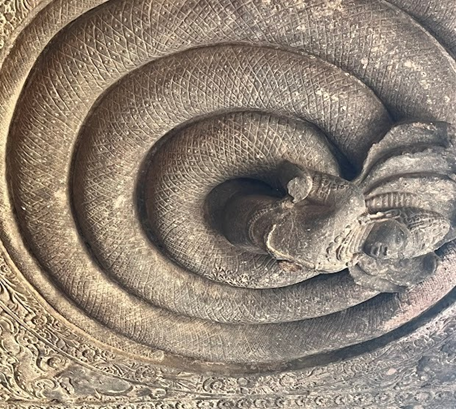
other Pauranic (mythological) figures. The prominent one is Shesh nag with body partly of snake.
Brackets supporting the cornice resemble lions known as Kirti
Mukhas, elephants, humans emerging from the mouths of makaras and aquatic
creatures. There are reliefs of Gods Brahma, Vishnu, Durga, Kartikeya,
Lakulisha etc., decorative medallions with Vidyadhara couples and foliations on
pillar-faces. The sanctuary doorframe carries on its architrave models of
northern-style temple-towers.
The sculpture-style is homogeneous and recalls that of
sculptures in the 8th-century Brahmanical caves at Elephanta and Ellora.
Craftsmen "Vachya', 'Buru' and 'Duttoja' have signed their names over the
facade of the cave.
Cave-3 was created in 578 CE by Chalukya Mangalesha, in the
reign of his step-brother Kirtivarma-I for the God Maha-Vishnu. Like the two
earlier caves, its plan comprises of an open verandah and a pillared-hall with a
sanctuary cut into its rear wall. Being the largest and most ornate of all the Chalukya caves, it is executed on an ambitious scale. The cave has a
stone structural enclosure. A Sanskrit inscription carved beside the great
Varaha relief in the verandah, details its dedication date and gift of village Lanjisvara
(Nandikesvara) by Mangalesha.
The temple's verandah accommodates major super-human size figural compositions: eight-armed Vishnu, Ashtabhuja
(with eight hands) Vishnu. Vishnu seated
on Ananta and Bhu-Varaha (present in cave-1 as well) on the left side and Harihara
the right. The Bhu-Varaha sculpture is seen on more than one occasion because
Varaha was royal symbol of Chalukyas and it was carried on the coins (Gadyana).
It is rare site to see Vishnu seating on
Ananta. Generally Vishnu is seen supine on Ananta.
,
The statue is
depicting Chalukya Kings, sitting in this posture. Pulkeshi-II is usually depicted
in this fashion.

Majestically standing
Narasimha and Vamana-Trivikrama on the right, Narsimha presents itself in
different style. The relief of Narsimha is in Tribhanga posture and is termed
by locals as Vijay Narsimha (after killing Hiranyakashipu). Instead of Shankha
and Chakra human figures are seen in his hands. They are called as Ayudh
Purush. On top you see Vidyadhar couple flying with clouds around.
Side faces of beams carry narrative friezes of episodes from Mahabharata
and Puranas: Samudra-Manthana (churning of the ocean), Krishna's exploits and Parijata-Harana.
The verandah ceiling
bears medallion-reliefs of Vishnu (centre), Shiva, Indra, Varuna, Bramha
and Yama. The front row of verandah pillars has bracket-figures of
loving divine couples, like Siva-Parvati, Kama-Rati, Naga-Nagini, etc and
nayikas in moods under trees. The hall’s ceiling bears reliefs of brahma at the
centre surrounded by Indra(East), Varuna (West), Kubera (North-East) and Kartikeya
(South). An image of Vishnu's vehicle Garuda, is carved on verandah's eave by artist Nelavalke. The whole cave was beautifully painted
and a fragment surviving beside the Garuda relief depicts a royal couple
witnessing dance, testifying to the quality of painting.
Fresco in Ajanta caves
Fresco in Cave-3
Badami
One can notice the similarities between colours, shape of the
eyes and faces and different ear rings in each ear.
The image of Maha-Vishnu is
missing from the sanctuary. The craftsmen Kolimanchi, Singimanchi,
Aju-acharasiddhi, etc., have signed on the sides of the facade.
Cave-4 is a
Jaina cave-temple, the smallest among all the cave-temples at Badami and datable to early 7™ century
CE, same period as of the cave 1. This is the top-most cave temple and all in all, one must
climb 187 steps to reach this cave.

Its verandah walls
accommodate relief sculptures (in clockwise direction) of Adinath (Rishabhdeva)
first of the 24 Tirthankaras of Jainism. Carved on the left are seen 12
Tirthankaras around Bahubali. Bahubali (Gommatesvara) is one of the 100 sons of Rishabhdeva- Adinath, the first Tirthankar). Realising the futility of the material world after competing with his brother for the throne, he took to penance for 12 years standing, meditating in the forest. Creepers grew around
him. Standard iconography of Bahubali shows him naked and creepers growing
around his legs. Seen in the next relief is Parsvanatha who lived in 877 BCE and attained Moksha on Mount
Summeta (in present-day Madhuban in the State of Jharkhand). Also seen in the relief are his two sisters Brahmi (seemingly Brahmi script started with her) and Sundari. Parsvanatha is seen in penance in Koyatsarg
(Standing) position overcoming the obstacles of his demonic enemy Kamatha
(demon). The relief shows Kamatha on the top trying to interrupt and same
Kamatha has given up, surrendered and is seen worshiping Parshwanath on the left
of the statue. On the right of the statue is seen Padmavati holding diamond
umbrella.

Somewhat unfinished, it consists of an open verandah and an
oblong antechamber with a sanctuary piercing into its rear wall. The sanctuary
doorframe depicts Kama as the door-guardian. On the rear wall of the sanctuary
is the relief sculpture of a sermon-delivering tirthankara, probably Mahavira (early
6th Century BCE) with halo behind. Mahavira is seated on a lion-throne under
a chaitya-tree and triple-umbrella known as Mukkode. Mukkode, by some is
considered as indicative of emperorship by other as Trilokas. Three umbrellas
are also interpreted as the three jewels in Jainism viz. Samyak Darshana (Right
perception or self-realisation), Samyak Jnana (Right knowledge) and Samyak
Charitra (Right character). On both sides he is attended by chauri-bearers’ men.
Vidyadhara couple is offering flowers on the top and divine drums (Dev Dundubhi) are beating by
themselves. There are several smaller and larger figures of tirthankaras in the
antechamber. The small lady, seated beside a tirthankara, carved at the right
side of the entrance to the cave is Jakkave. A pious votary who attained
salvation according to the Jaina vow is called Sallekhana. Kolimanchi is among the
craftsmen who have signed on the boulder of the cave. The cave was originally
accessed from the East side and separated from cave-3 by a stone wall. This
stone wall apparently was opened during 16th Century by Vijaynagar
(Hampi Kings). It is interesting to note that Cave-1 and 4 where carved
simultaneously during the same period by Chalukya. Jainism had reached
Karnataka during 330 BCE and was recognised and respected by Chalukyas, hence
the cave at the top most point of the hill.
After climbing down around 187 steps from Cave 4 back to the
entrance of the cave temple, we had quick snacks and water and decided to go around Agastya Lake to reach Bhoothnath group of temples.
Agastya Lake, is man made and a dam is built around it. It was built using the stone, cut while carving
the cave temples. It is a beautiful walk around the lake leading to the Bhoothnath group
of temples built in 7th to 12th century. On the way one comes across
houses and villages.
Even before one
starts walking on the path, we come across two Islamic structures one is
Markaz Jumma, an 18th Century doomed tomb an evidence of Muslim rule.
It also has tomb of Malik Abdul Aziz first Governor appointed by Adilsha. Going
further we came across Archaeological Museum. The Archaeological Museum was
established in the year 1982 and houses 181 antiquities, including sculptures,
decorated architectural members and inscriptions found in and around Badami. We
were tired after climbing the cave temples and chose to skip the Museum and moved on to Bhoothnath
temple.
The
name comes from the mythology that Shiva killed demon called Bhoot at this
site. It is worth noticing that no binding material is used while errecting the
temple. The temple structure is simple and can be identified in three different
sections. Adhishtan (plinth or base), Bhitti (walls) and Shikhar (top). This
temple can be said to be in Dravidian style. Walls are plain without carvings
and Shikhar is also simple. The walls have square and rectangular sections
following one another. They are known as Bhadra and Subhadra. On top of them
rising as Shikhar one sees square and rectangle, their number reducing (lantern
roof) as we go up. The last is known as Vimana. Typical of Dravidian style of
architecture. This is combined work of Badami
Chalukya (6th Century) and Kalyani Chalukya (around 11th
Century). The distinguishing factor is introduction of Jali on windows
and round shaped pillars. Bhoothanath is Shiva temple. As you approach garbh
griha, one sees two statues at the base of the door frame one on the left and
another on the right of the door frame. These are sculptures of river goddesses.
The left is Ganga and the right is Yamuna. Yamuna is seen on turtle and Ganga on
crocodile. There is assistant seen with umbrella indicting that these are goddesses. As a custom one has to wash his feet before
entering the temple. This requirement is fulfilled as you symbolically cross these
rivers. The Shivalinga is new and undated though the stone used is same. Dwarpalakas
are seen and are not in Chalukya style, as informed, they were distorted by
another architect (artist) from Vajrayan panth from Pallavas (Mahabalipuram,
Kanchi).
At the southeastern end of Bhoothnath
group is a cave shrine, in which there are rock-cut relief sculptures, the
prominent one being of Vishnu.
It is cave temple with Anantshayana. Vishnu
is seen with Shridevi massaging his leg and Bhudevi near the head and Garuda
standing in attention. The cave is small and one has to bend down to enter.
From the naval of Vishnu one can see lotus with Brahma. With the help of Brahma, Vishnu took Dashavatar (ten incarnations). Those are carved on both sides of
Brahma starting with Matsya (fish) and ending with Kalki (yet to come) seen
with the horse.
Carved on the left of this relief (not seen
in the picture), wall is decorated with temple with Shikhar and Trimurti
(Vishnu, Mahesh and Brahma). Below them their transport is seen Garuda is
complete, while others are not complete.
After meanigful long day, we returned back to
Badami Court Hotel for the night. next day we planned to Aihole and
Pattadakal to see some more temples.
More in the next Blog.